
Your Warehouse Is Probably Taller Than It Is Full
Walk down almost any aisle in Jebel Ali, Al Quoz or Dubai Investment Park and look up. More often than not, the top beam sits a couple of metres below the roof steel and the space above it holds nothing but air. That air is already paid for. Using it is usually the cheapest storage a UAE business can add.
The cost of the alternative keeps rising. Knight Frank’s UAE Industrial and Logistics Market Review 2026 puts Grade A rents in Al Quoz at an average of AED 90 per square foot, up 6% year on year, and reports Dubai South rents up 22% to AED 55. Occupiers also lodged 12.3 million sq ft of new industrial and logistics requirements in Dubai in the first half of 2026. When a bigger building means paying more per square foot as well as for more square feet, growing upwards starts to look very sensible.
This guide walks through how to do it safely: what limits your usable height, which storage changes add the most positions, and which forklift rental options make a taller, tighter layout work day to day.
Start With Your Real Usable Height
The number that matters is not the height of the roof. It is the clear height to the lowest obstruction: roof beams, lighting, ducts and, above all, sprinkler heads.
Dubai Municipality’s Technical Guidelines for Safe Storage (DM-HSD-148-SS2, June 2026) are specific on this point: if the warehouse is equipped with a sprinkler system, stored material must not be closer than 45 centimetres to the walls, partitions or sprinkler heads. Measure to the lowest head, subtract that clearance, and you have the ceiling for your top load.
The same guideline notes that pallet racking generally has no strict height limit as long as it is properly designed to support the weight and the goods. That is not a licence to build to the roof. The building’s fire protection has to be designed for the storage height you plan, so talk to the landlord and a fire-safety consultant about the UAE Fire and Life Safety Code before you order taller frames.
Then work down from the top. Every level needs clearance above the load so the forks can lift it off the beam and withdraw. Your racking designer sets those clearances; the European standard EN 15620 exists precisely so that the chance of a truck or pallet striking the structure stays acceptably low.
Check the Floor Before You Go Higher
Height magnifies floor problems. The UK Health and Safety Executive’s guide HSG76, Warehousing and storage says racking should be erected on sound, level floors capable of withstanding the point loading at each base plate. Hyster’s floor flatness guidance for very narrow aisle trucks puts it plainly: small variations between the wheel tracks are magnified in direct proportion to the height of the racking.
Many UAE warehouses were built for block stacking or low racking. A floor survey costs far less than discovering, after the racking is installed, that the mast sways at nine metres.
Seven Ways to Add Storage Without Adding Floor Space
1. Re-rack to the height you actually have
The simplest gain is often taller selective racking with one or two extra beam levels. Each pallet stays individually accessible, so picking does not slow down. Every bay must carry a clear notice stating its maximum load, a requirement spelled out in HSG76. If you are weighing up different racking types, our guide to pallet racking systems compares them side by side.
2. Narrow the aisles
Aisles are where most warehouses lose space. The truck you run decides how narrow they can go:
| Truck | Typical working aisle | Source |
|---|---|---|
| Counterbalance forklift | 3.2 – 3.5 m | Mecalux |
| Reach truck | 2.7 – 2.9 m | Mecalux |
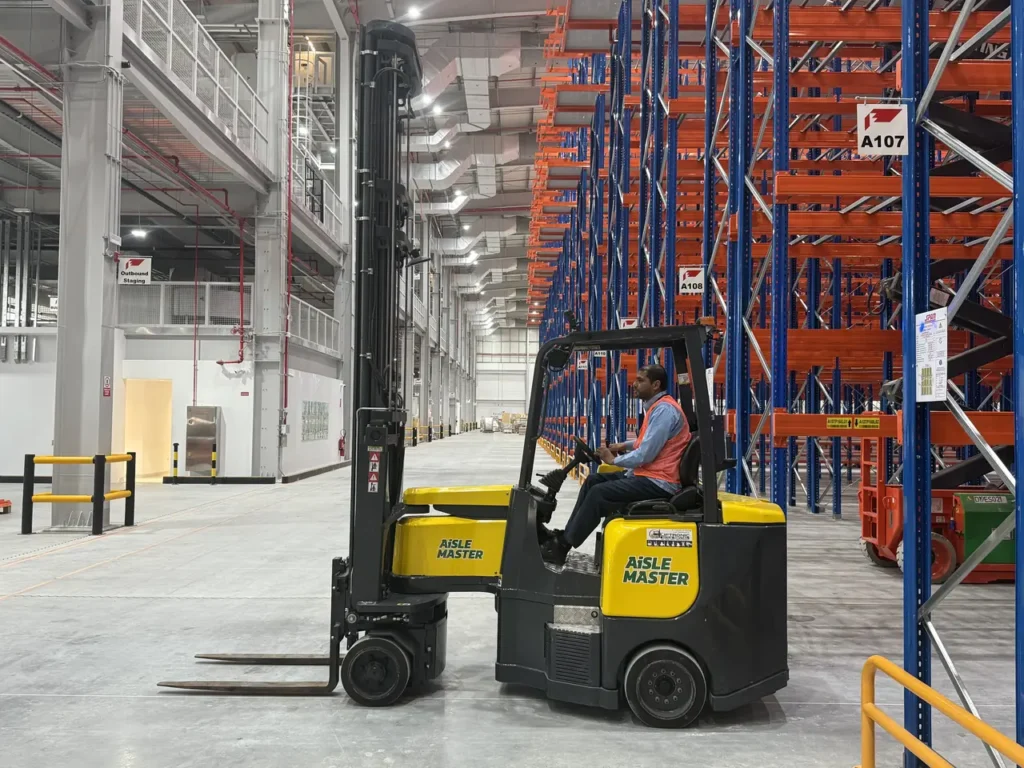
| Articulated forklift | from 1.6 m | Combilift (Aisle Master) |
| VNA turret truck | 1.5 – 1.9 m | Mecalux |
Figures come from Mecalux and Combilift; the real figure for your site depends on the pallet size and the model. A reach truck is the standard choice for high racking indoors. An articulated forklift goes narrower and, unlike a turret truck, can also drive outside to the loading bay. Combilift says its Aisle Master range can increase warehouse storage by up to 50% and lift as high as 15 metres. Treat that as the manufacturer’s best case, because your gain depends on how far you re-rack. Our introduction to articulated forklifts explains how they work, and the narrow aisle and VNA comparison goes brand by brand.
3. Store two pallets deep
Double-deep racking puts two pallets behind each other on each side of the aisle, which removes aisles altogether. Mecalux notes that trucks working this layout should be equipped with telescopic forks, usually a reach truck with a double-deep or telescopic reach fork. The trade-off is access: you reach the rear pallet only after moving the front one, so it suits products with two or more pallets per SKU.
4. Use dense storage for bulk lines
Drive-in, push-back and pallet-flow racking pack pallets into deep lanes. They suit high-volume, low-variety stock such as beverages, building materials or seasonal goods. Each changes how stock rotates (first-in-first-out or last-in-first-out), which is why the choice needs care. The racking guide covers each one.
5. Add a mezzanine floor for picking and light goods
A steel mezzanine floor turns the height above a picking, packing or returns area into a second working level. It works best for cartons, spare parts and e-commerce picking rather than full pallets. A mezzanine is a structure in its own right, so it needs a structural design, a check of the floor slab beneath its columns and your landlord’s consent before anything is ordered.
6. Pick at height without a forklift
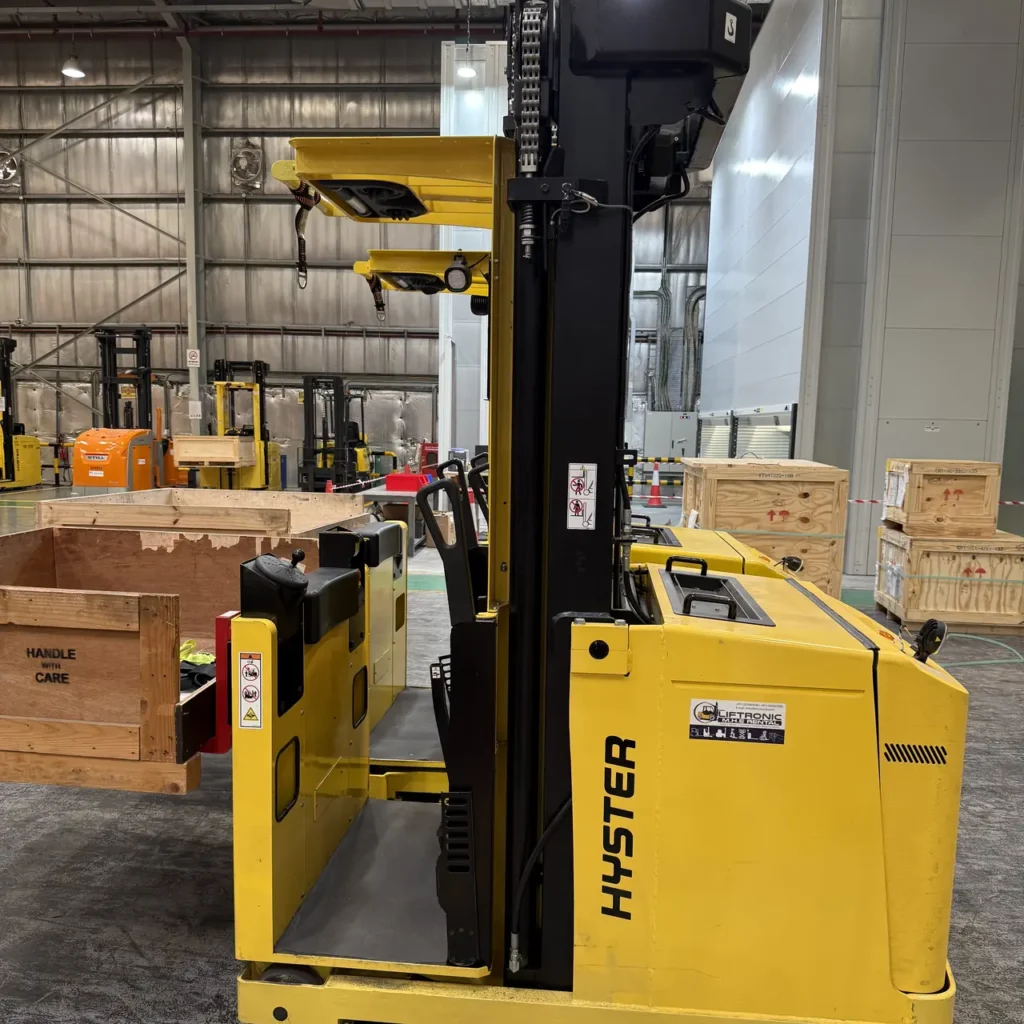
If the goal is to pick cases from upper levels rather than move whole pallets, an order picker lifts the operator with the platform, so stock can sit higher without slowing picking. For the lower levels and short runs, an electric pallet stacker is a compact, low-cost option.
7. Slot stock by how often it moves
A taller warehouse only works if the right goods sit at the right height. Keep fast-moving lines low and close to the dock, and put slow movers and reserve stock in the top levels. It costs nothing, and it often recovers more throughput than new equipment does.
Keep It Safe as It Gets Taller
Higher racking concentrates more stock, and more risk, in each bay. HSG76 recommends in-house racking inspections at weekly or other regular intervals based on risk assessment, and an inspection by a technically competent person at intervals of not more than 12 months. Any damage should be reported as soon as anyone sees it.
Visibility is the other issue. At eight or ten metres the operator is judging a pallet they can barely see. Dubai Municipality’s External Circular 01/2026 on Safe Forklift Operation requires industrial establishments to fit 360-degree cameras and proximity sensors to forklifts, keep a daily pre-operation inspection log and ensure operators receive accredited training, with full implementation no later than 1 January 2027. Our forklift camera systems, including the AI 360° forklift camera, are a direct way to meet the camera requirement.
Trial the Layout Before You Re-Rack
Converting to narrow aisles or double-deep storage is a commitment: new racking, new traffic routes, retrained operators. Renting the truck first lets you test it in a pilot aisle with your own pallets and your own floor. Liftronic rents reach trucks, articulated forklifts from Aisle-Master, Bendi and Flexi, order pickers and stackers across the UAE, delivered from our Jebel Ali yard and maintained by our own technicians. There are more reasons to rent than cash flow alone.
Tell us your clear height, current aisle width and pallet sizes, and we will suggest the truck that gets the most out of them. Get in touch for a recommendation.
Frequently Asked Questions
How can I increase warehouse storage without moving to a bigger building?
Use the height you already have. The main options are taller racking, narrower aisles with a reach truck or articulated forklift, double-deep or other dense racking for bulk lines, and a mezzanine floor for picking and light goods. Most warehouses combine two or three of these.
How close can stored goods be to sprinkler heads in Dubai?
Dubai Municipality’s Technical Guidelines for Safe Storage (DM-HSD-148-SS2) state that, where a sprinkler system is installed, stored material must not be closer than 45 centimetres to the walls, partitions or sprinkler heads.
Is converting to narrow aisles worth it?
It depends on how much aisle space you recover and whether your floor and building height suit it. Combilift quotes up to 50% more storage with its Aisle Master range, but that is a best case. Renting a narrow aisle truck for a pilot aisle is the easiest way to check the gain before committing to new racking.
Do I need a different forklift for taller racking?
Often, yes. A forklift’s usable capacity falls as the mast extends, so check the capacity at your highest beam level with the load you actually lift. Reach trucks and articulated forklifts are designed for high racking; most counterbalance trucks are not.
Can I add a mezzanine floor in a rented warehouse?
Usually, but it needs the landlord’s consent, a structural design and a check of the floor slab under the columns. Ask about approvals before you order, because a mezzanine changes the building’s layout and its fire and escape arrangements.
References
- Knight Frank — UAE Industrial and Logistics Market Review 2026 (29 Jul 2026)
- Dubai Municipality — Technical Guidelines for Safe Storage, DM-HSD-148-SS2 V1.0 (June 2026)
- Dubai Municipality — External Circular 01/2026, Safe Forklift Operation (10 Jun 2026)
- UK HSE — HSG76 Warehousing and storage: A guide to health and safety
- Hyster — Floor Flatness: Why it’s important (VNA flyer)
- EN 15620:2021 — Steel static storage systems, tolerances, deformations and clearances (abstract)
- Combilift — Aisle Master articulated forklifts
- Mecalux — Types of forklifts and their aisle widths
- Mecalux — Pallet racking (selective and double-deep)