
Wireless Forklift Camera System in UAE
Wireless forklift camera systems for forklifts, reach trucks, warehouses and material handling equipment across Dubai, Abu Dhabi, Sharjah and the UAE
Forklifts can have restricted visibility around the forks, load, mast, rear area and sides of the machine. A wireless forklift camera system provides an additional camera view for the operator without requiring a conventional video cable between the camera and monitor.
Liftronic Machinery & Equipment Rental L.L.C. provides wireless forklift camera solutions for material handling applications across the UAE, including fork-view cameras, rear-view cameras, front-view cameras, side-view cameras, magnetic wireless cameras and other application-specific configurations.
Depending on the selected system, wireless forklift cameras can provide features such as HD video, wireless video transmission, recording, laser positioning, AI detection and specialized camera configurations for different operating environments.
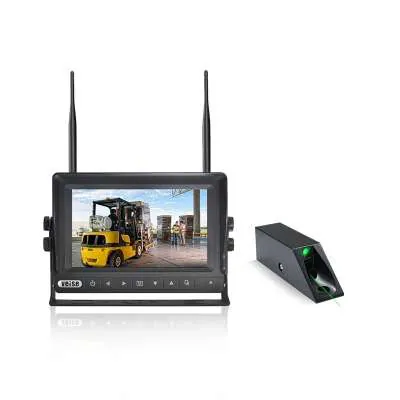
What Is a Wireless Forklift Camera?
A wireless forklift camera is a camera system that sends video from a camera installed on a forklift to a monitor using wireless transmission rather than a conventional video cable between the camera and display.
A typical system can include:
- Forklift camera
- Wireless transmitter
- Wireless receiver
- Operator monitor
- Camera power supply
- Mounting system
- Optional battery
- Optional additional cameras
- Optional laser positioning
The exact components and specifications depend on the selected camera system.
Wireless camera technology can be particularly relevant where conventional cable routing is difficult, such as applications involving moving mast sections or fork-mounted cameras.
Types of Wireless Forklift Cameras
Different forklift applications require different camera positions and functions.
Wireless Fork-View Camera
A wireless fork-view camera is installed to provide a view of the forks and load area.
It can be used for applications involving:
- Fork alignment
- Pallet entry
- Load positioning
- High-level pallet handling
- Restricted fork visibility
Some wireless fork cameras are available with laser positioning, providing a visual reference for fork positioning.
Wireless Front-View Camera
A front-view camera provides an additional view toward the front working area of the forklift.
It can be considered where the mast, carriage or load restricts the operator's direct view.
Wireless Rear-View Camera
A wireless rear-view camera provides a camera view toward the rear of the forklift.
It can be used as an additional visual aid during reversing and manoeuvring.
Wireless Side-View Camera
Side-view cameras can be used where visibility toward the sides of the forklift is required.
The camera location should be selected according to the machine structure and operating application.
Magnetic Wireless Forklift Camera
Some wireless forklift camera systems use magnetic mounting.
This type of installation can be suitable for applications where a removable or repositionable camera is required and where the forklift structure permits secure magnetic mounting.
External battery-powered configurations are also available on some systems.
Wireless AI Camera
Wireless forklift camera systems are available with AI-based functions, depending on the selected product.
Possible functions include:
- Pedestrian detection
- Vehicle detection
- Pallet detection
- Warning functions
- Video recording
AI functions and detection capabilities vary between systems and should be confirmed for the specific model being supplied.
Heated Wireless Camera
Specialized cameras are available for low-temperature environments.
Heated or defogging camera configurations can be considered for cold stores and refrigerated environments where condensation, fogging or frost may affect the camera lens.
The exact temperature range and heating function depend on the selected camera model.
Wireless Camera with Laser Positioning
A wireless fork camera can be equipped with laser positioning on compatible systems.
The laser provides a visual reference that can assist the operator when positioning the forks relative to a pallet or load.
Why Is a Wireless Forklift Camera Important?
Forklift cameras are used to provide additional visual information where direct operator visibility is restricted.
The importance of the camera depends on the forklift model, load, mast configuration, operating environment and camera position.
Wider View
A wide-angle camera can show a larger area from its mounting position than a narrow-angle camera.
Depending on the selected camera and installation, the operator may be able to view:
- Forks
- Fork tips
- Load area
- Rear area
- Front working area
- Side area
The actual viewing angle depends on the camera specification and installation position.
Fewer Blind Spots
Forklift blind areas can result from:
- Mast
- Load
- Fork carriage
- Counterweight
- Racking
- Machine structure
- Operator position
Installing an additional camera in an appropriate location can provide visibility of an area that is difficult to observe directly.
The camera does not eliminate all blind spots, and correct positioning is essential.
Fast Installation
Wireless camera systems can reduce the requirement for video cable routing between the camera and monitor.
This can be useful for:
- Fork-mounted cameras
- Moving mast applications
- Temporary equipment installations
- Camera systems requiring flexible mounting arrangements
Installation time depends on the forklift model, camera configuration, mounting method and power connection.
Industrial Application
Forklift camera equipment can be selected according to the conditions in which the forklift operates.
Relevant specifications may include:
- Waterproof rating
- Operating temperature
- Shock and vibration resistance
- Camera housing
- Power requirements
- Wireless transmission specifications
- Mounting method
These specifications should be checked against the actual application before installation.
Wireless Forklift Camera Applications
Liftronic can supply or configure camera solutions for applications involving:
- Counterbalance forklifts
- Electric forklifts
- Diesel forklifts
- Reach trucks
- Articulated forklifts
- Narrow-aisle equipment
- Warehouse MHE
- Pallet handling
- Loading and unloading
- Manufacturing facilities
- Distribution centres
- Logistics warehouses
- Cold stores
- Industrial facilities
- Ports and terminals
The camera type should be selected according to the equipment and the specific visibility requirement.
Wireless Forklift Camera for UAE Warehouses & Industrial Areas
Liftronic supports forklift camera requirements across the UAE.
Dubai
- Jebel Ali
- JAFZA
- Al Quoz
- Dubai South
- Dubai Industrial City
Abu Dhabi
- KIZAD
- KEZAD
- Industrial areas
- Logistics facilities
- Port-related operations
Sharjah
- Sharjah Industrial Areas
- Hamriyah Free Zone
- SAIF Zone
Northern Emirates
- Ajman
- Umm Al Quwain
- Ras Al Khaimah
- Fujairah
- Fujairah Port
- Fujairah Free Zone
Wireless Forklift Camera vs Wired Camera
The correct solution depends on the forklift, camera position, power supply, operating environment and required functions.
| Feature | Wireless Camera | Wired Camera |
|---|---|---|
| Video connection | Wireless transmission | Cable connection |
| Cable routing between camera and monitor | Reduced | Required |
| Fork-mounted applications | Suitable for selected systems | Requires protected cable routing |
| Moving mast applications | Can simplify video connection | Requires appropriate cable management |
| Camera relocation | Depends on mounting system | Requires cable adjustment |
| Recording | Available on selected systems | Available on selected systems |
| AI functions | Available on selected systems | Available on selected systems |
| Laser positioning | Available on selected systems | Available on selected systems |
Wireless HD monitor: technical specifications (WL-LIFT-AO78HD)
From Liftronic's 7-inch wireless HD camera system brochure.
| Specification | Value |
|---|---|
| Screen | 7-inch IPS |
| Wireless receiver | Built-in 4-channel 2.4G |
| Picture modes | Single / double / triple / quad |
| Operating frequency | 2400–2483.5 MHz |
| Recording | TF card up to 256GB, AVI format |
| Receiving distance | Up to 200 m, clear line of sight |
| Resolution | 1024 x 600 |
| Brightness | 600 cd/m² |
| Operating temperature | –20°C to +70°C |
| Operating voltage | DC 11–32V |
| Dimensions | 216 x 150 x 80 mm |
Wireless HD camera: technical specifications (CA-777)
| Specification | Value |
|---|---|
| Image sensor | 1/2.9 colour CMOS |
| Resolution | 1080P (1920 x 1080) |
| Wireless transmission | Built-in 2.4G digital transmitter, 18dBm |
| Transmit distance | Up to 200 m, clear line of sight |
| Visible angle | 52° |
| Housing | 304 stainless steel, anti-collision |
| Laser positioning | Green slotted laser |
| Protection | IP69K |
| Operating voltage | DC 12V |
| Operating temperature | –20°C to +60°C |
| Dimensions | 116 x 37 x 30 mm |
Rechargeable power supply: technical specifications (PB-990)
| Specification | Value |
|---|---|
| Cell type | Lithium-ion polymer |
| Capacity | 111Wh / 30,000mAh |
| Rated capacity | 7,500mAh (12V 0.5A) |
| USB input | 5V 15W, 9V/12V 18W |
| DC output | 12V (0.8A), 9.6W max |
| Protection | IP67 |
| Discharge temperature | –20°C to +55°C |
| Dimensions | 148 x 88 x 46.5 mm |
Wireless Forklift Camera Installation
Proper installation is important for obtaining the intended camera view.
Liftronic can assess:
- Camera mounting location
- Camera viewing angle
- Monitor position
- Power connection
- Battery arrangement
- Wireless communication
- Cable routing for power
- Camera protection
- Mounting security
- Clearance around moving forklift components
For fork-mounted cameras, the installation should not interfere with normal fork movement, pallet handling or other forklift functions.
The camera lens should also be kept clean and the mounting position checked periodically.
Why Choose Liftronic for Wireless Forklift Cameras?
Liftronic Machinery & Equipment Rental L.L.C. provides material handling equipment solutions and can assist customers in selecting camera configurations according to their forklift and operating requirements.
Available camera solutions can include:
- Wireless forklift cameras
- Wireless fork-view cameras
- Wireless rear-view cameras
- Front-view cameras
- Side-view cameras
- Magnetic wireless cameras
- AI wireless cameras
- Laser-positioning cameras
- Cold-store camera solutions
- Video recording systems
- Additional camera configurations
- Camera installation
- Fleet camera deployment
Liftronic can assess the forklift model, mast configuration, camera location, operating environment and visibility requirement before recommending a suitable configuration.
Frequently Asked Questions
Get a Wireless Forklift Camera from Liftronic
If your forklift requires additional fork, front, rear or side visibility, Liftronic can assess the equipment and recommend a suitable wireless camera configuration.
Available configurations can include:
Wireless Fork Camera + Rear Camera + Front/Side Camera + Monitor + Recording + AI Detection + Laser Positioning
The final specification should be selected according to the forklift model, application and required camera functions.
Frequently Asked Questions
What is a wireless forklift camera?
A wireless forklift camera transmits video from a camera installed on a forklift to a monitor using wireless communication rather than a conventional video cable between the camera and monitor.
What types of wireless forklift cameras are available?
Wireless forklift camera configurations can include fork-view, front-view, rear-view, side-view, magnetic, AI, laser-positioning and heated cameras, depending on the manufacturer and application.
Can a wireless camera be installed on forklift forks?
Yes. Wireless fork-view cameras are available for applications where the operator requires a camera view of the forks and load area. The mounting arrangement must be suitable for the specific forklift.
Can a wireless forklift camera reduce blind spots?
An additional camera can provide visibility of areas that are difficult to see directly. It does not eliminate every blind area, and camera position and viewing angle must be selected appropriately.
Is a wireless forklift camera faster to install than a wired camera?
Wireless systems can reduce the requirement for video cable routing between the camera and monitor. Actual installation time depends on the forklift, mounting arrangement, power connection and selected camera system.
Can wireless forklift cameras have laser positioning?
Yes. Selected wireless fork-view camera systems are available with laser positioning for applications involving fork and pallet alignment.
Can wireless forklift cameras be used in cold stores?
Yes. Specialized heated or defogging camera systems are available for low-temperature applications. The operating temperature and heating specifications must be confirmed for the selected model.
Can a wireless forklift camera record video?
Selected wireless camera systems support video recording. Recording capability, resolution and storage depend on the monitor and camera configuration.
Can AI pedestrian detection be added to a wireless forklift camera?
Selected wireless AI camera systems provide pedestrian and vehicle detection. The exact detection functions depend on the specific system and configuration.
Can wireless cameras be used on reach trucks?
Yes. Wireless cameras can be considered for reach trucks, particularly where visibility of the forks, load or rear area is required. Camera placement should account for the mast and reach-truck structure.
Can Liftronic provide wireless forklift cameras in JAFZA?
Yes. Liftronic can support suitable wireless forklift camera requirements for warehouses and logistics operations in JAFZA and Jebel Ali.
Can Liftronic supply wireless forklift cameras in KIZAD and KEZAD?
Yes. Wireless forklift camera solutions can be considered for suitable warehouse, logistics and industrial applications in KIZAD/KEZAD.
Does a wireless forklift camera replace normal forklift safety procedures?
No. A camera is an additional visibility aid. It does not replace operator training, pedestrian segregation, traffic management, safe operating procedures or other applicable safety controls.
What information does Liftronic need to recommend a wireless forklift camera?
Liftronic can assess the following:; Forklift make and model Capacity Mast type Lift height Camera position required Number of forklifts Operating environment Visibility problem Recording requirement AI detection requirement Laser positioning requirement Cold-storage requirement