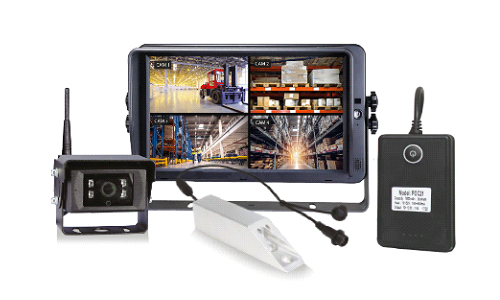
Forklift Camera & MHE Camera Systems in UAE
Improve operator visibility with forklift camera and MHE camera systems for warehouses, logistics facilities, manufacturing plants, distribution centres, ports and industrial operations across the UAE. Liftronic Machinery & Equipment Rental provides forklift camera solutions including fork-view, wireless, mast, rear-view, side-view, recording, 360° and AI-enabled camera systems.
A correctly selected camera gives the operator an additional visual view of areas that may be difficult to see directly, including fork tips, pallet pockets, elevated loads, rear travel areas, rack positions and blind spots.
The right camera configuration depends on the forklift type, mast height, load, operating environment, visibility limitation and whether the application requires recording, 360° coverage or AI-assisted pedestrian detection.

What Is a Forklift Camera System?
A forklift camera system is an industrial camera and display solution installed on a forklift or other material handling equipment (MHE) to provide the operator with an additional view of the working area.
Depending on the application, a system can provide visibility of the forks, mast, load, rear travel path, side areas or the surroundings of the machine. More advanced systems can combine multiple cameras to create a 360° surround view or provide AI-assisted detection of pedestrians and vehicles.
Forklift cameras can be particularly useful where visibility is affected by:
- Raised loads
- Forklift masts
- High-level racking
- Narrow aisles
- Rear blind spots
- Side obstructions
- Large loads
- Loading and unloading operations
- Pedestrian and vehicle interaction
A camera is an additional visibility and safety aid. It should not replace trained operators, pedestrian segregation, physical guarding, traffic-management systems or safe operating procedures.
Dubai Municipality's current forklift guidance specifically addresses camera systems including 360° cameras, mast cameras, industrial-grade components, operator displays, calibration and training.
Why Use a Camera on a Forklift?
Better Fork and Pallet Visibility
When forks are raised or a load restricts the operator's direct view, seeing the fork tips and pallet pockets can become difficult. A fork-view or mast camera provides an additional view of the fork and load interface.
This can be particularly useful for high-rack pallet handling with reach trucks and counterbalance forklifts.
Improved Blind-Spot Awareness
Rear and side cameras can provide additional visual information when reversing, turning or working around racks, loads and other equipment.
More Accurate Load Positioning
A camera can help operators visually align forks with pallet openings and rack positions. This can be valuable when handling pallets at height or operating in narrow aisles.
Additional Visibility Around the Machine
A multi-camera or 360° system can provide a wider view around the forklift than a single rear or fork camera.
Video Recording
Camera systems with recording capability can provide video information for incident investigation, near-miss review, equipment-damage assessment and operator training, subject to the company's applicable privacy and data-retention policies.
Additional Pedestrian Awareness
AI-enabled camera systems can provide warnings when pedestrians or vehicles enter configured detection areas. These systems should be treated as an additional safety control rather than a replacement for proper warehouse traffic management.
Types of Forklift & MHE Cameras
Different MHE applications require different camera positions and configurations.
The correct configuration should be selected according to the forklift, operating environment and actual visibility problem.
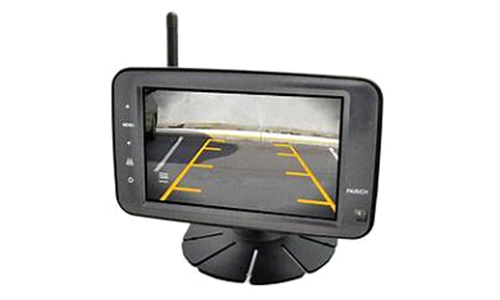
Liftronic's current forklift-camera offering includes wired and wireless configurations, including wireless fork-mounted cameras, rechargeable battery options and monitor systems.
| Camera Type | Typical Mounting Position | Main Purpose | Suitable MHE | Key Benefit |
|---|---|---|---|---|
| Fork View Camera | Fork carriage/fork area | View fork tips and pallet pockets | Forklift, reach truck | Better fork positioning |
| Wireless Fork Camera | Fork carriage/mast | Cable-free fork visibility | Forklift, reach truck | Flexible installation |
| Mast Camera | Mast/front structure | View around load/mast obstruction | Reach truck, forklift | Additional high-level visibility |
| Rear View Camera | Rear counterweight | View rear travel area | Forklift, reach truck | Additional reversing awareness |
| Side View Camera | Side frame/body | Monitor side blind areas | Forklift/MHE | Wider lateral visibility |
| Front View Camera | Front/mast area | Additional forward view | Forklift/MHE | Improved forward awareness |
| Load View Camera | Mast/carriage | View elevated load | High-rack equipment | Better load positioning |
| 360° Camera | Front, rear and sides | Surround/bird's-eye view | Forklift/MHE | Wider surrounding visibility |
| AI 360° Camera | Multi-camera configuration | Surround view and AI detection | Forklift/MHE | Additional pedestrian/vehicle awareness |
| Recording Camera | Machine/body | Video recording | Fleet applications | Incident and operational review |
| Low-Light Camera | Front/rear/side | Low-light visibility | Indoor/outdoor MHE | Additional visibility in darker areas |
Forklift Camera Technical Specifications
Forklift cameras operate in demanding environments where equipment can be exposed to vibration, dust, moisture, impact and temperature changes. The camera specification therefore needs to match the actual operating environment.
Typical specifications may include:
Liftronic's current camera information includes configurations with HD/1080P imaging, IP69K protection, multi-camera input, recording and trigger functionality, depending on the selected system.
For UAE industrial environments, the camera, wiring, monitor and mounting components should be selected according to the actual application. Dubai Municipality's forklift guidance recommends industrial-grade components with suitable IP protection for camera installations. (
| Specification | Typical Configuration |
|---|---|
| Resolution | HD / 1080P and application-dependent options |
| Camera configuration | Single or multiple cameras |
| Transmission | Wired or wireless |
| Display | Industrial LCD/HD monitor |
| Viewing angle | Selected according to application |
| Recording | Optional, system-dependent |
| Storage | SD/TF card or recorder-dependent |
| Protection | Industrial IP-rated options |
| Night visibility | Available on selected systems |
| Power | Forklift electrical system or rechargeable battery |
| Mounting | Fixed, magnetic or application-specific |
| Trigger | Reverse/auxiliary trigger depending on system |
| Image adjustment | Normal/mirror view depending on system |
| AI detection | Optional on compatible systems |
| 360° view | Multi-camera configuration |
AI 360° Forklift Camera & Pedestrian Detection
AI-enabled forklift cameras combine conventional video visibility with computer-vision technology.
What Is an AI Forklift Camera?
An AI forklift camera uses computer vision to analyze camera images and identify configured objects such as pedestrians or vehicles.
Depending on the system, it can provide visual or audible alerts when an object enters a configured detection area.
AI-enabled systems are increasingly being used for additional awareness in warehouses and industrial facilities where forklifts operate close to pedestrians or other vehicles.
How Does a 360° Forklift Camera Work?
A 360° system normally uses several wide-angle cameras positioned around the forklift.
The camera images are processed to create a surrounding or bird's-eye view displayed on the operator monitor.
A typical configuration may use front, rear and side cameras to cover areas around the machine.
Dubai Municipality's current guidance describes a four-camera surround system capable of providing a 360° bird's-eye view and also identifies mast cameras for situations where the mast or raised load obstructs visibility.
AI Pedestrian Detection
AI-enabled systems can identify pedestrians or vehicles within configured detection zones.
Depending on the system, features can include:
- Visual warnings
- Audible warnings
- Detection-zone configuration
- Pedestrian recognition
- Vehicle recognition
- Multi-camera coverage
- Recording
- Monitor alerts
Some specialist forklift AI systems use camera-based detection without requiring pedestrians to carry electronic tags.
AI detection performance depends on factors such as camera positioning, lighting, obstruction, system configuration and calibration. It should therefore complement established warehouse safety controls rather than replace them.
Forklift Camera Applications Across the UAE
Forklift and MHE camera systems can be configured for warehouses, logistics facilities, manufacturing plants, ports, free zones and industrial operations throughout the UAE.
Dubai Warehouses and Distribution Centres
Forklift cameras can support high-rack storage, pallet handling, loading areas and busy warehouse operations across Dubai.
Fork-view, mast, rear-view and 360° systems can be selected according to the visibility requirements of the facility.
JAFZA and Jebel Ali Logistics Operations
JAFZA and the wider Jebel Ali area support extensive logistics, warehousing, distribution and industrial activities.
Forklifts operating in these environments may work around:
- High pallet racking
- Loading bays
- Container and cargo areas
- Distribution warehouses
- Staging areas
- Mixed vehicle traffic
Fork-view and mast cameras can assist with pallet positioning, while rear, side and 360° camera systems can provide additional surrounding visibility.
Wireless fork cameras can also be considered where cable routing to the carriage is difficult.
Abu Dhabi, KIZAD and KEZAD Industrial Operations
KIZAD/KEZAD supports large-scale industrial, logistics and warehousing activities in Abu Dhabi.
Forklifts and other MHE can operate across warehouses, manufacturing facilities, logistics centres and industrial yards where visibility requirements can vary significantly.
Camera selection should consider:
- Mast height
- Load dimensions
- Operating distance
- Outdoor exposure
- Dust
- Lighting
- Pedestrian movement
- Vehicle interaction
Depending on the application, a forklift may use a fork camera, mast camera, rear camera, side camera or complete 360° configuration.
Manufacturing Facilities
Manufacturing sites can have forklifts operating close to production machinery, raw materials, finished goods and employees.
Rear, side and 360° systems can provide additional visual information where the forklift structure or load restricts direct visibility.
Ports, Free Zones and Industrial Areas
Forklift cameras can also support material-handling operations around UAE ports, logistics hubs and industrial areas, including Jebel Ali/JAFZA and KIZAD/KEZAD.
Potential applications include:
- Warehouse pallet handling
- Loading and unloading
- High-rack storage
- Cargo and staging operations
- Yard activities
- Distribution centres
- Manufacturing
- Logistics operations
Cold Storage
Cold-store operations require careful selection of cameras, monitors, batteries, cables and other components according to the operating temperature.
A suitable camera system can provide additional visibility during pallet handling and high-level storage operations.
Sharjah and Northern Emirates
Liftronic can support MHE camera requirements for operations in Sharjah, Ajman, Umm Al Quwain, Ras Al Khaimah and Fujairah, as well as Dubai and Abu Dhabi, depending on the equipment and application.
Forklift Camera Systems for Different MHE
Counterbalance Forklifts
Rear-view, fork-view and optional 360° camera systems can be selected according to the forklift's operating environment.
Reach Trucks
Mast and fork-view cameras are particularly relevant to high-rack pallet handling where the mast, carriage or load can restrict direct visibility.
Articulated Forklifts
Fork, front and rear cameras can be configured according to aisle dimensions and the direction of operation.
VNA Forklifts
Camera placement can focus on fork positioning, rack interfaces and narrow-aisle visibility.
Order Pickers
Front, rear and operator-area visibility can be considered according to the machine and application.
Pallet Stackers
Compact front or fork-view systems may be appropriate for pallet handling and positioning.
Side Loaders
Front and side visibility can be important where loads and travel direction create restricted viewing areas.
Heavy-Duty Forklifts
Multi-camera systems can be considered where large machines, loads or operating areas create multiple visibility limitations.
How to Choose the Right Forklift Camera
The right camera should be selected according to the actual visibility problem rather than simply choosing the highest specification.
1. Identify the Blind Spot
Determine exactly what the operator cannot see.
Is the problem the fork tips, rear travel path, side area, high-level pallet, load or surrounding pedestrian traffic?
2. Identify the MHE
Provide the:
- Make and model
- Capacity
- Mast type
- Lift height
- Operating voltage
- Attachment, if applicable
3. Select the Camera Position
The application may require a fork, mast, rear, side, load or multi-camera 360° system.
4. Consider the Environment
Consider whether the equipment operates:
- Indoors
- Outdoors
- In dusty conditions
- In wet conditions
- In cold storage
- In narrow aisles
- Around high pedestrian traffic
5. Decide on Recording and AI
Recording can be useful where incident review is important. AI pedestrian detection and 360° systems may be considered for areas with higher interaction between forklifts, pedestrians and vehicles.
Forklift Camera Installation in UAE
Correct installation is as important as camera selection.
For wired systems, cables should be routed and protected from moving mast sections, sharp edges, heat, hydraulic components and mechanical damage.
Wireless systems can simplify installation and are particularly useful for some fork-mounted applications.
The monitor should be securely positioned within the operator's normal viewing area without creating another obstruction.
Dubai Municipality's current guidance addresses secure monitor installation, suitable positioning, calibration and periodic testing by competent personnel.
Forklift Camera Maintenance & Calibration
Forklift camera systems should be included in the equipment's inspection and maintenance program.
Recommended checks include:
- Camera lens condition
- Camera mounting
- Cable condition
- Wireless battery condition
- Monitor operation
- Image quality
- Camera alignment
- Recording function
- AI detection zones
- Alert functions
- System calibration
Camera alignment should be checked after installation, relocation or any work that could change the camera position.
Dubai Municipality's current guidance calls for calibration, function testing and maintenance of relevant inspection and calibration records.
Why Choose Liftronic for Forklift Camera & MHE Solutions?
Liftronic combines forklift and material-handling equipment experience with technical support, allowing camera requirements to be considered together with the actual MHE application.
Liftronic provides solutions covering:
- Forklift rental
- Used forklifts
- Forklift repair and service
- Reach trucks
- Articulated forklifts
- Electric forklifts
- Warehouse equipment
- Forklift attachments
- Forklift camera systems
The company's technical capability across different forklift makes and models is important when selecting a camera because the correct installation depends on mast design, carriage configuration, lift height, power supply, operating conditions and the actual location of the blind spot.
Whether the requirement is a wireless fork camera, rear-view camera, mast camera, recording system, 360° camera or AI-enabled pedestrian-detection system, Liftronic can assess the application and recommend a suitable configuration.
Frequently Asked Questions
Need a Forklift Camera System in the UAE?
Liftronic can assess your forklift or MHE visibility requirements and recommend a suitable camera configuration for your operation.
For a camera assessment or quotation, provide:
- Forklift/MHE type
- Make and model
- Quantity
- Lift height
- Operating location
- Main visibility problem
- Wired or wireless preference
- Recording requirement
- AI pedestrian detection requirement
- 360° camera requirement
Contact Liftronic for forklift camera and MHE camera solutions across the UAE, including Dubai, JAFZA/Jebel Ali, Abu Dhabi, KIZAD/KEZAD, Sharjah and the Northern Emirates.
Forklift camera systems gallery
Frequently Asked Questions
What is a forklift camera?
A forklift camera is an industrial camera system installed on a forklift or MHE to provide the operator with an additional view of areas that may be difficult to see directly. Depending on the application, it can provide fork, mast, rear, side, load, recording or 360° visibility.
What types of forklift cameras are available?
Common configurations include fork-view, wireless fork, mast, rear-view, side-view, front-view, load-view, recording, 360° and AI-enabled camera systems.
Can a forklift camera be installed on a reach truck?
Yes. Reach trucks can use fork-view or mast-mounted cameras to provide additional visibility during high-rack pallet handling. The mounting arrangement should be selected according to the reach truck model, mast design and lift height.
What is an AI forklift camera?
An AI forklift camera uses computer vision to identify configured objects such as pedestrians or vehicles within its detection area. Depending on the system, it can provide visual or audible alerts.
What is an AI 360° forklift camera?
An AI 360° forklift camera combines multiple cameras around the forklift to create a surrounding view and can add AI-based detection capabilities where supported.
Can forklift cameras detect pedestrians?
Some AI-enabled systems can identify visible pedestrians within configured detection zones. Performance depends on camera positioning, environmental conditions and system configuration. AI detection should be used as an additional safety control rather than a replacement for established safety procedures. (
Are wireless forklift cameras available?
Yes. Wireless forklift camera systems are available for applications including fork and mast visibility. Liftronic offers wireless configurations with camera, monitor and rechargeable battery options.
Can forklift cameras record video?
Selected systems can include video recording. Storage capacity, recording method and number of channels depend on the selected configuration.
Are forklift cameras suitable for UAE outdoor operations?
Yes, provided the selected equipment has suitable environmental protection and is correctly installed for the operating conditions.
Can forklift cameras be used in cold stores?
Yes, provided the complete camera system is suitable for the operating temperature. The camera, monitor, battery, wiring and other components should be assessed for the specific environment.
How much does a forklift camera cost in the UAE?
The cost depends on the camera type, number of cameras, monitor, wired or wireless configuration, recording, AI functions, 360° capability and installation requirements. Liftronic can recommend a configuration based on the actual MHE application.
How do I choose the right forklift camera?
Provide the forklift make and model, lift height, main visibility problem, operating environment, number of forklifts and whether you require recording, AI pedestrian detection or 360° coverage. These details help determine the appropriate camera configuration.