
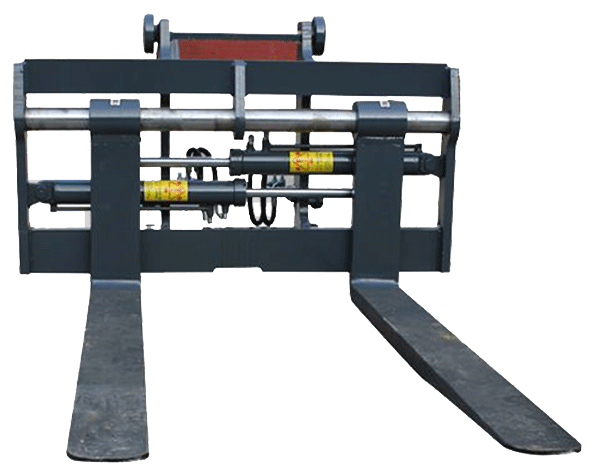
A fork positioner is a hydraulic attachment that adjusts the spacing between the forks, so the operator can move the forks in or out from the seat instead of repositioning them by hand.
Liftronic Machinery supplies fork positioners for sale in Dubai, Abu Dhabi, Sharjah and across the UAE, for warehouses, logistics operations, distribution centres and factories where one forklift handles different pallet sizes or load widths.
The right fork positioner is not chosen from the forklift's tonnage alone. The forklift model, carriage class, fork dimensions, attachment weight, load centre, hydraulic functions, maximum load and application all need to be considered.
Fork spacing decides how well the forks engage and support a load. Operations that handle different pallet widths, fork entry points, product sizes, packaging or non-standard loads force operators with fixed forks to stop, get off and move the forks every time the load changes. A hydraulic fork positioner makes the same adjustment from the forklift controls.
Hydraulic fork positioner vs manual fork adjustment
Feature
Manual fork adjustment
Hydraulic fork positioner
Fork movement
Manual
Hydraulic
Operator adjustment
Operator repositions the forks by hand
Controlled from the forklift
Different load widths
Less convenient
More flexible
Frequent adjustment
Time-consuming
Quick
Hydraulic function
Not required
Required
Compatibility
Standard carriage and forks
Attachment-specific
Manual adjustment works well where the same pallet is handled all day. Frequent changes in load width favour a hydraulic positioner.
Where fork positioners are used
Warehouse pallet handling: Pallets with different dimensions or fork-entry requirements.
Logistics operations: Goods arriving from many suppliers on different pallet types.
Distribution centres: High-volume handling with fewer manual fork adjustments.
Manufacturing: Raw materials, components, finished goods and production supplies.
Industrial handling: Crated equipment, machinery and special load carriers of varying width.
How a fork positioner works
Approach the pallet or load with the forks at a suitable height.
Use the hydraulic control to set the fork spacing.
Align the forks with the pallet openings or lifting points.
Insert the forks to the correct depth.
Lift and transport within the forklift and attachment capacity.
Typical fork positioner specifications
Specification
Typical value
Carriage class
ISO 2, 3 and 4
Mounting
Hook-on or integral
Typical capacity range
1,500 – 8,000 kg
Function
Adjusts fork spacing, optionally with side shift
Hydraulic services
One function, or two with side shift
Adjustment range, attachment weight and exact capacity depend on the model. Do not use generic figures for a specific fork positioner without the manufacturer's data.
Fork positioner capacity and forklift capacity
Once fitted, the fork positioner's own weight becomes part of the lifting configuration. Available capacity is also affected by the load centre, load dimensions, mast configuration, lift height, carriage and fork position, so the correct capacity must come from the forklift and attachment manufacturers' specifications.
A suitable fork positioner can be used on 3-ton and 5-ton forklifts when it matches the carriage, hydraulic system and capacity. 7 and 10-ton forklifts need larger, heavy-duty positioners, where rated capacity, structure, carriage compatibility and hydraulics become particularly important.
Fork positioner compatibility checklist
Forklift: Brand, model, capacity and mast configuration.
Carriage: Carriage class, width and mounting arrangement.
Forks: Length, width, thickness and the adjustment range you need.
Load: Maximum weight, width, length, load centre and load type.
Hydraulics: Available functions, connections, and pressure and flow where applicable.
Buying a fork positioner in the UAE
Before purchase we confirm forklift compatibility, attachment capacity, adjustment range, carriage class, hydraulic configuration, load centre and attachment weight.
New, used and refurbished fork positioners may be available. Condition, inspection status and refurbishment scope are confirmed for each attachment.
Safe use
A fork positioner does not replace good operating practice. Set the forks correctly for the load so it stays stable, stay within the maximum permitted load and load centre, check visibility, the operating surface and lift height, and follow the manufacturer's instructions.
A hydraulic attachment that lets the operator adjust the spacing between the forks without repositioning them by hand.
Why use a fork positioner?
It saves time and manual effort when a forklift regularly handles pallets or loads of different widths.
Is a fork positioner the same as a side shifter?
No. A fork positioner changes the spacing between the forks; a side shifter moves the forks or attachment sideways. Combined units do both.
Can a fork positioner be installed on any forklift?
No. Compatibility depends on the forklift model, carriage class, hydraulic system, attachment weight, capacity, load centre and application.
Can a fork positioner be used on a 3, 5 or 10 ton forklift?
Yes, when the model is matched to the forklift. Heavier forklifts need heavy-duty positioners whose specifications and mounting suit the truck.
Does a fork positioner reduce forklift capacity?
It can. The attachment adds weight and can change the effective load centre, so available capacity must be confirmed for the complete configuration.
What information is needed to select a fork positioner?
Forklift brand and model, capacity, carriage class, fork dimensions, maximum load weight, load dimensions, load centre, hydraulic configuration and application.
Can I buy a fork positioner in Dubai, Abu Dhabi or Sharjah?
Yes, subject to the required model and current availability. Send us your forklift and application details.