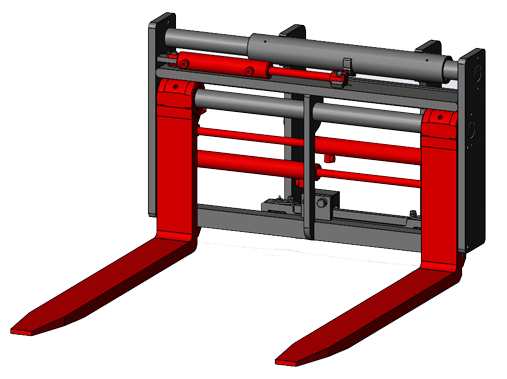
A side shifter is a hydraulic forklift attachment that moves the forks, or the whole load, sideways to the left or right without the operator having to reposition the forklift.
It is the most widely used forklift attachment and is fitted as standard on many new trucks. Liftronic Machinery supplies side shifters for sale in Dubai, Abu Dhabi, Sharjah and across the UAE, for warehouses, logistics operations, container loading and factories.
The right side shifter depends on the forklift's capacity and carriage class, the heaviest load handled, whether a hook-on or integral design suits the truck, and whether fork positioning is needed as well.
Without a side shifter, lining a pallet up with a rack position, a trailer bed or another stack means reversing, turning and approaching again, sometimes several times. With one, the operator stops roughly in line and moves the load the last few centimetres from the seat.
That means fewer truck movements, less tyre and drivetrain wear, less risk of hitting racking uprights or the load next door, and faster, more accurate placement, especially in narrow aisles and inside containers where there is no room to manoeuvre.
How a side shifter works
The side shifter mounts on the forklift carriage and the forks hang on the side shifter's own fork bar. A double-acting hydraulic cylinder slides that fork bar across the carriage on wear pads or bearings. Fork spacing does not change: the forks and load move together as one unit.
Side-shift travel is limited, typically around 100 mm each way depending on the model. It is a fine-positioning tool, not a replacement for driving the truck into position.
Approach the pallet or rack position roughly in line.
Engage and lift the load.
Use the side-shift lever to move the load left or right into exact alignment.
Place the load and return the side shifter to the centre position before travelling.
Hook-on vs integral side shifters
Feature
Hook-on (external) side shifter
Integral side shifter
Mounting
Hangs on the existing carriage
Replaces the carriage
Moving between trucks
Easy, if carriage classes match
Not practical
Added length in front of carriage
More
Less
Effect on residual capacity
Larger reduction
Smaller reduction
Operator visibility
Slightly reduced
Better
Typical use
Retrofit to existing trucks
Factory-fitted on new trucks
Combined units that side shift and position the forks are also available. See the fork positioner page.
Typical loads and applications
Warehousing and distribution: Putting pallets away in selective racking with tight beam clearances.
Container and truck loading: Placing pallets tightly side by side where the truck cannot turn.
Block stacking: Aligning pallets on top of each other so stacks stay square and stable.
Manufacturing: Feeding production lines and placing loads accurately at workstations.
Yards and building materials: Positioning blocks, bagged goods and palletised materials outdoors.
Typical side shifter specifications
Specification
Typical value
Carriage class
ISO 2, 3 and 4
Mounting
Hook-on (external) or integral
Typical capacity range
2,500 – 8,000 kg
Function
Sideways movement of the forks and load
Side-shift travel
Model dependent, typically around 100 mm each way
Hydraulic services needed
One auxiliary function
Exact capacity, travel, weight and load-centre loss depend on the model and must be taken from the manufacturer's data.
How to choose a side shifter
Check the forklift's brand, model and rated capacity.
Find the heaviest load you will handle, and its load centre.
Confirm the carriage class (ISO 2, 3 or 4) and carriage width.
Decide between hook-on and integral, based on whether the unit must move between trucks.
Check the truck has a spare auxiliary hydraulic function, or whether a valve kit is needed.
Decide whether you also need fork positioning, in which case a combined unit may be better.
Capacity and compatibility
A side shifter adds weight to the front of the truck and moves the forks, and so the load, further forward. Both reduce the forklift's residual capacity. A hook-on unit typically costs more capacity than an integral one. The actual figure depends on the truck, the attachment and the load centre, and the capacity plate should be updated for the truck and side shifter combination.
Side shifters are available for 2.5 to 8-ton trucks and beyond. The attachment's capacity rating must be at least the truck's working load, and it must match the carriage class. A side shifter for a 5-ton truck will not hang correctly on a smaller class carriage, and vice versa.
Safe use and maintenance
Side shift with the load low and the mast upright wherever possible. Shifting a heavy load at full height moves the combined centre of gravity sideways and reduces stability. Return the side shifter to centre before travelling, and never use side shift to push or drag loads.
Routine checks include the wear pads or bearings, lubrication of the sliding surfaces, hydraulic hoses and fittings for leaks, and the retaining hooks and fork locks. Worn pads cause jerky movement and extra play at the fork tips.
Buying a side shifter in the UAE
Side shifters are available to buy, new or used, subject to availability. Tell us your forklift model, capacity and carriage class and we will recommend a suitable unit and advise on fitting.
It moves the forks and load left or right while the truck stays still, so the operator can place pallets precisely in racking, trailers and stacks without repeatedly moving the forklift.
How far does a side shifter move?
It depends on the model; travel of around 100 mm each way is typical. It is designed for fine positioning, not large sideways movements.
Is a side shifter the same as a fork positioner?
No. A side shifter moves both forks together sideways; a fork positioner changes the spacing between the forks. Combined units do both.
Does a side shifter reduce forklift capacity?
Yes. Its weight and the distance it adds in front of the carriage reduce residual capacity. Integral side shifters lose less than hook-on types.
What is the difference between hook-on and integral side shifters?
A hook-on side shifter hangs on the existing carriage and can move between trucks with the same carriage class. An integral side shifter replaces the carriage, keeping the load closer to the mast.
Can a side shifter be fitted to an older forklift?
Usually, yes. A hook-on side shifter fits a truck with the matching ISO carriage class and a spare auxiliary hydraulic function, or one can be added.
What hydraulics does a side shifter need?
One auxiliary hydraulic function, which is a single extra lever on most trucks.
Can I buy a side shifter in Dubai?
Yes, subject to the carriage class and current availability. Send us your forklift details.