
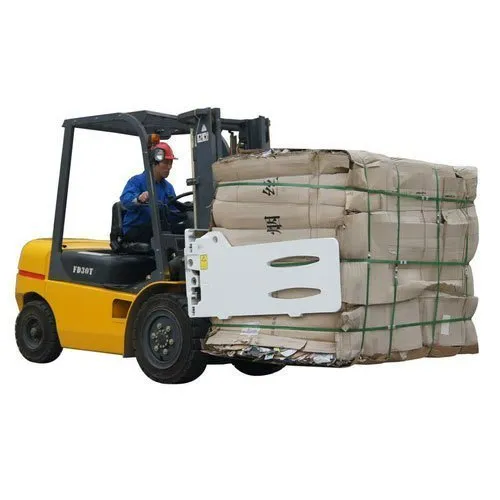
A bale clamp is an attachment that grips compressed bales from the sides, so a forklift can pick up, stack and move them without pallets.
Liftronic Machinery supplies bale clamps for sale in Dubai, Abu Dhabi, Sharjah and across the UAE, for paper, cardboard, textile, recycling and waste bales.
Selecting the correct bale clamp takes more than knowing the forklift capacity: bale weight, dimensions, density and surface, the gripping range, clamp capacity, attachment weight, load centre, carriage class and hydraulics all need to be considered.
Standard forks are designed for loads supported from underneath. A compressed bale may:
Not be palletised
Be too large for convenient fork entry
Need side gripping
Have a deformable surface
Need to stay intact during transport
Be handled repeatedly in high volumes
A bale clamp grips the bale rather than relying on support from below, which suits operations moving large numbers of bales. It must still be selected for the bale and the application.
What bales can a bale clamp handle?
Paper and cardboard bales: Common in paper and cardboard recycling.
Textile bales: Textile recycling and manufacturing.
Recycling bales: Different materials compressed for storage or transport.
Waste bales: Compacted material in waste-management operations.
A clamp designed for one material is not automatically suitable for every type of bale.
Bale information needed before selecting a clamp
Maximum bale weight, not only the average
Bale length
Bale width, which sets the clamp opening and contact area
Bale height
Bale density, which affects the gripping force needed
Surface: soft, hard, wrapped, strapped, irregular or loose
How stable the bale is during lifting and transport
Gripping range, clamp pressure and contact pads
Gripping range is the span of bale widths the clamp can open to and close on. Always check the manufacturer's range against your minimum and maximum bale width and height.
The clamp needs enough force to hold the bale securely, but excessive or inappropriate pressure can damage paper, cardboard, textiles, soft materials and wrapped products. Where adjustable pressure is available, set it to the manufacturer's instructions. Contact area, pad design and surface material also affect load security and product protection, so the clamp should not be chosen on maximum capacity alone.
Key bale clamp specifications
Specification
Typical value or what to confirm
Carriage class
ISO 2, 3 and 4
Mounting
Hook-on
Typical capacity range
2,000 – 5,000 kg
Function
Clamp, optionally with rotation and side shift
Hydraulic services
Two to three functions
Rated capacity
Maximum permitted attachment load
Clamp opening
Minimum and maximum gripping range
Contact pads
Size and configuration for the material
Attachment weight and load centre
Required for the capacity assessment
Actual figures must be confirmed against the selected model.
Bale clamp capacity is more than bale weight
The complete configuration is forklift + attachment + bale. The clamp adds weight and the load centre can change compared with standard forks, so a 3, 5, 7 or 10-ton forklift does not keep that usable capacity with a bale clamp fitted.
Lighter bale handling can suit 3-ton forklifts, heavier bales 5-ton forklifts, and heavy-duty recycling and industrial bales may need 7 or 10-ton forklifts, always with the residual capacity established for the complete configuration.
How to select the right bale clamp
Identify the material: paper, textile, recycling material or another bale type.
Record the heaviest bale.
Measure the bale's length, width and height.
Check how tightly compressed the bale is.
Check the surface: wrapped, strapped, loose or irregular.
Work out the clamp opening needed for the actual bale dimensions.
Check the forklift's capacity, model, carriage and hydraulics.
Evaluate the forklift, attachment and bale together.
Where bale clamps are used
Paper recycling facilities
Textile recycling
Waste management
Recycling centres handling different bale types
Manufacturing plants receiving raw materials in bales
Warehouses storing bales
Buying a bale clamp in the UAE
Bale clamps are available for operations that handle bales every day, from recycling and waste handling to production and warehousing.
New, used and refurbished bale clamps may be available. Condition, inspection information and refurbishment scope are confirmed for each attachment. Damaged, unstable or poorly compressed bales add handling risk, so always operate within the attachment's rated limits.