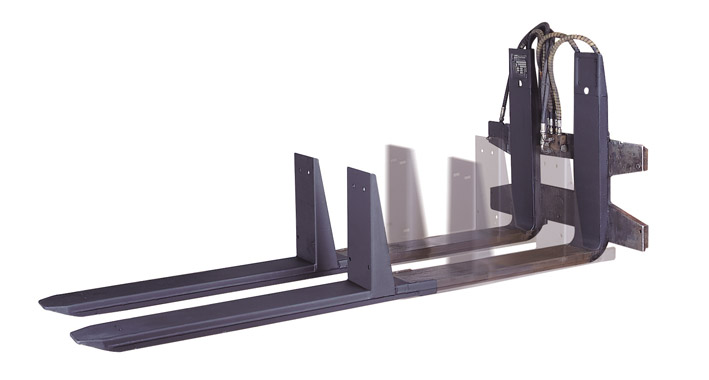
Telescopic forks, also known as double deep forks, hydraulic forks or reach forks, are forklift attachments whose fork length extends and retracts hydraulically, giving extra reach only when it is needed.
Liftronic Machinery supplies telescopic forks for sale in Dubai, Abu Dhabi, Sharjah and across the UAE, for double-deep pallet racking, reach trucks, deep storage and other warehouse and logistics jobs where standard forks cannot reach.
The right telescopic fork depends on the forklift, pallet dimensions, load weight, load centre, storage configuration and the extension length required. Extension and capacity are model-dependent.
In single-deep racking, the forklift places each pallet straight into an accessible position. In double-deep racking, a second pallet sits further inside the rack, and standard forks cannot safely reach it. Telescopic forks provide that extra reach.
The typical sequence: the forklift approaches the rack, the forks enter the pallet, the forks extend hydraulically, the pallet is placed in the deep position, the forks retract and the forklift exits. The exact method depends on the rack design and attachment configuration.
Telescopic forks vs extra-long fixed forks
Extra-long fixed forks give more reach, but stay long for every job. Telescopic forks stay short when normal reach is enough and extend when it is not, which makes them more versatile. Reference designs are built to reduce base length for the same extension, which can reduce turning radius.
Feature
Standard fixed forks
Telescopic forks
Fork length
Fixed
Extends and retracts
Double-deep storage
Limited by reach
Suitable for compatible applications
Normal pallet handling
Excellent
Excellent when correctly selected
Additional reach
Needs longer forks
Available through extension
Load capacity
Fixed by configuration
Differs between retracted and extended
Warehouse flexibility
Standard
Higher where variable reach is needed
How hydraulic telescopic forks work
A hydraulic cylinder extends and retracts the outer fork section, controlled from the operator's position. This helps where fork extension changes often, double-deep storage is used, access to the attachment is limited, or manual extension would be impractical. The forklift's hydraulic system must be compatible with the attachment.
Telescopic forks for reach trucks
The reference model is developed specifically for reach trucks, with a design intended to reduce turning radius and fork deflection. Consider it where aisles are restricted, double-deep racks are installed, pallet positions are deeper than normal fork reach, and storage density is a priority. The reach truck and attachment must be assessed together before installation.
Retracted vs extended capacity
This is the most important technical point. When the forks extend, the load moves further from the forklift, the load centre increases and the allowable capacity falls. That is why telescopic fork specifications give separate ratings for the retracted and extended positions.
Longer reach does not mean the forklift can lift the same weight at the same height. Always check load weight, load centre, fork extension, lift height, mast, attachment weight and forklift capacity against the manufacturer's load chart.
Example specification: reference TFG2 range
Retracted fork lengths from about 1,200 mm to 1,350 mm
Base dimensions from about 950 mm to 1,100 mm
Rated capacity of 3,000 kg at 600 mm load centre when retracted
Lower permissible capacity when extended, depending on configuration
ISO/FEM Class II mounting
For forklifts up to 2.5 tonnes
Pair weight about 180 – 200 kg
These are reference-model figures, not universal values. Confirm the exact capacity and dimensions for the telescopic forks selected for your forklift.
Key specifications to check
Specification
Why it matters
Fork length retracted and extended
Normal and maximum reach
Rated capacity retracted and extended
Safe load in each position
Load centre
Decides effective capacity
Fork cross-section and tip
Mechanical and pallet compatibility
Carriage class
Mounting compatibility
Attachment weight
Affects residual forklift capacity
Cylinder configuration and stroke
Hydraulic operation and extra reach
Overall dimensions
Warehouse clearance
Cold stores and logistics warehouses
Distribution centres, logistics and FMCG warehouses, cold stores, manufacturing warehouses and third-party logistics sites use telescopic forks to increase storage density, evaluated together as forklift + attachment + rack + pallet + load + aisle. In cold stores, also tell us the operating temperature, hydraulic and lubrication requirements and corrosion protection needed. The benefit is greatest where extra reach is needed repeatedly, not only occasionally.
When telescopic forks are, and are not, the right choice
They are worth considering when you use double-deep racking, your reach truck needs extra reach, you need variable extension, standard forks cannot reach the pallet position, longer fixed forks would be inconvenient, or space is limited.
They may not be necessary when all pallets are single-deep, standard forks already reach, the extra attachment weight is not justified, loads exceed the attachment's capacity, rack clearances are unsuitable, the forklift lacks the hydraulic function or the carriage is incompatible, or the extension creates an unacceptable load centre.
Buying telescopic forks in the UAE
Liftronic Machinery supplies new, used and refurbished telescopic forks, replacement forks and double-deep storage solutions, subject to specification and stock. Brands include Cascade, Bolzoni, ATIB, KAUP, Griptech and CAM.