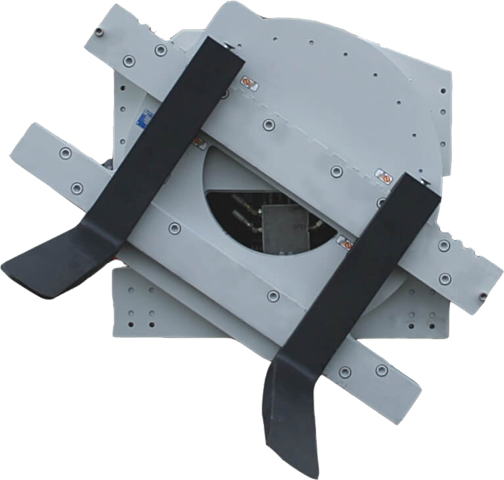
A fork rotator is a hydraulic attachment that turns the forks and the load through a specified angle, so a forklift can tip, invert or reposition a load instead of only lifting and moving it.
Liftronic Machinery supplies fork rotators for sale in Dubai, Abu Dhabi, Sharjah and across the UAE, for manufacturing, recycling, waste handling, industrial processing and container handling.
The most important selection factors are load weight, load dimensions, rotation range, load centre, attachment weight, forklift capacity, carriage class and hydraulic requirements. A rotator should be chosen around the complete application, not the forklift's nominal tonnage.
Transferring material from one container to another
For example, if a container must be lifted and tipped to discharge its contents, a rotator gives a more controlled method than unloading it by hand. Not every load is suitable for rotation, so the application must be checked first.
What loads can a rotator handle?
Start with the load: its maximum weight (not the average), its length, width, height or diameter, and its shape, whether a box, cylinder, container, pallet, irregular item, liquid-filled container or loose material.
The load's centre of gravity matters most, because it moves as the load turns, and the load must stay supported and secured throughout the movement. A rotator designed for one type of load should not be assumed to suit another.
Rotation range: 90°, inversion or 360°
Different jobs need different movement: partial rotation, 90° rotation, full inversion, or continuous 360° rotation. Specify the range before choosing a model, because not every rotator offers the same range.
Controlled rotation speed is just as important when handling fragile products, liquid-filled containers, unstable loads or heavy components that could shift as they turn.
Key rotator specifications
Specification
Typical value or why it matters
Typical capacity range
2,000 – 5,000 kg
Rotation
Up to 360°, continuous, depending on model
Mounting
Hook-on
Function
Rotation, optionally with side shift
Special versions
Foundry, fishing-industry and explosion-proof models
Attachment weight
Adds to the lifting configuration and reduces residual capacity
Load centre
Decides the forklift's available capacity
Carriage class and hydraulics
Must match the forklift
Actual specifications must be confirmed against the selected manufacturer's model.
How a fork rotator works
Position → engage → lift → rotate → reposition → lower. The operator aligns the attachment with the load, engages it as the manufacturer instructs, raises it only as far as needed within capacity, turns it through the permitted range with the hydraulic rotation function, then places it in the required position.
Rotators for 3 to 10 ton forklifts
Rotators can be configured for 3-ton forklifts in lighter manufacturing, recycling and material-transfer work, for 5-ton forklifts handling heavier loads, and for 7 and 10-ton forklifts in heavy industrial applications, where load dimensions and centre of gravity become critical.
Forklift capacity does not equal rotator operating capacity. The rotator's own specification and the resulting forklift capacity must always be checked.
Compatibility and capacity
The rotator and forklift work as one system. Check the forklift model, carriage class, the hydraulic function available, attachment weight, load centre, fork dimensions and lift height. Physical fit is not enough: a technical compatibility check should be completed before purchase or installation.
A rotator can significantly reduce available capacity, because it adds weight and the load centre can change with the attachment design and load position. The permissible load must come from the manufacturer's specifications for the complete configuration.
Rotator safety
Rotation creates risks that ordinary pallet lifting does not. Before operating, check the attachment's rated capacity and the forklift's residual capacity, the load's centre of gravity and security, the rotation range, the condition of the attachment and hydraulics, the working area and operator visibility. Take particular care where a load could shift, spill or become unstable, and use the rotator only for the applications it is designed and rated for.
Buying a fork rotator in the UAE
Rotators are supplied for long-term applications once the rotation range, load, capacity, carriage and hydraulics are confirmed.
New, used and refurbished rotators may be available depending on stock. Condition, inspection details and refurbishment scope are confirmed for each attachment.
Get a Fork Rotator Quote
Send us the following details:
Forklift brand, model, capacity and lift height
Carriage class and hydraulic functions, if known
Load type, maximum weight and dimensions
Centre of gravity, if known
Required rotation angle, and whether the load is inverted or emptied