Liftronic

Push-Pull Attachment in UAE

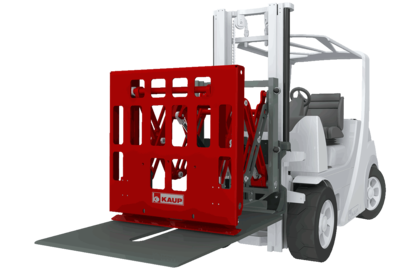
A push-pull attachment is a forklift attachment that pulls loads onto flat platens and pushes them off again, so goods can be handled on thin slip sheets instead of pallets.

Removing the pallet saves its cost, weight and height. More goods fit into each container, there are no pallets to return, store or repair, and there is no pallet wood to fumigate for export.

Liftronic Machinery supplies push-pull attachments for sale in Dubai, Abu Dhabi, Sharjah and across the UAE. The right unit depends on load weight and footprint, the slip sheet type, whether a fork-mounted unit is enough, and the forklift's capacity and hydraulics.

Get a Push-Pull Quote

Push-Pull Attachment

What is a slip sheet?

A slip sheet is a thin sheet of paper, plastic or fibreboard placed under a unit load in place of a pallet. It has a lip, or tab, on one or more sides that the push-pull attachment grips.

Slip sheets are a few millimetres thick and weigh very little, while a wooden pallet adds typically 15 cm of height and 15–25 kg or more to every load. Across a full container, that difference can mean noticeably more cartons shipped per box.

How a push-pull attachment works

  1. The operator lowers the platens to floor level and extends the pantograph (scissor mechanism) to the load.
  2. The gripper bar closes on the slip sheet's lip.
  3. The pantograph retracts, sliding the load onto the platens.
  4. The load is lifted and moved like any other.
  5. At the destination, the gripper releases and the pantograph pushes the load off the platens.

Push-pull types

  • Platen push-pull: Wide steel platens replace the forks. Best for dedicated, high-volume slip-sheet operations.
  • Fork-mounted (quick-mount) push-pull: Slides onto the truck's existing forks and can be removed when pallets need handling. Suits mixed operations.
  • Push-pull with side shift: Adds sideways positioning for container loading and tight stacking.
  • Push-off only: Pushes loads off the forks without a gripper; used where loads arrive on the forks but need to be placed without a pallet.

Typical loads and industries

  • Food and beverage: Cartoned and bagged goods for export and distribution.
  • Bagged commodities: Sugar, flour, rice, grains and fertiliser.
  • Light industry and electronics: Uniform cartoned products moved in high volume.
  • Container shipping: Loads where every centimetre of container height counts.
  • Paper and packaging: Stacked sheets and flat-packed boxes.

Typical push-pull specifications

SpecificationTypical value
Carriage classISO 2 and 3
MountingHook-on, or quick-mount directly on the forks
Typical capacity range1,700 – 2,400 kg
FunctionPulls loads onto platens and pushes them off
Slip sheetsPaper, plastic or fibreboard
Hydraulic services neededTwo functions (three with side shift)

Platen size, pantograph reach and attachment weight depend on the model.

Push-pull vs pallets

FeaturePallets and forksSlip sheets and push-pull
Height added per loadTypically about 15 cmA few millimetres
Weight added per loadTypically 15–25 kg or moreVery little
Returns and storagePallets must be returned, stored or replacedNone
Export treatmentWooden pallets may need treatmentNot needed for paper or plastic sheets
Receiving siteAny forkliftNeeds push-pull, or transfer to pallets
Forklift capacityFull rating with forksReduced by the attachment

How to choose a push-pull attachment

  1. Record the weight and footprint of the heaviest load.
  2. Choose the slip sheet material and lip size, and which sides need lips.
  3. Check whether customers and suppliers can also handle slip-sheet loads.
  4. Decide between a dedicated platen unit and a quick-mount unit on existing forks.
  5. Decide whether side shift is needed for container loading.
  6. Check the forklift's capacity, carriage class and auxiliary hydraulic functions.

Capacity and compatibility

Push-pull attachments are heavy and long, so residual capacity drops noticeably. They are usually fitted to trucks of 2.5 tonnes or more, and the load chart for the truck and attachment combination must be checked before use.

The truck needs two auxiliary hydraulic functions, or three if side shift is included. Floors should be smooth and clean, as the platens run close to the ground.

Buying a push-pull attachment in the UAE

Push-pull attachments are available to buy, subject to availability. Send us your load and forklift details and we will recommend a configuration.

Get a Push-Pull Quote

Send us the following details:

  • Load type, weight and footprint
  • Slip sheet material and lip size
  • Platen or quick-mount preference
  • Side shift needed?
  • Forklift brand, model and capacity
  • Carriage class and hydraulic functions

Request a quoteCall +971 52 248 3348

Frequently Asked Questions

What is a slip sheet?

A thin sheet of paper, plastic or fibreboard with a lip on one or more sides, used in place of a pallet under a unit load.

Why use push-pull instead of pallets?

Slip sheets cost less, weigh almost nothing and take far less height, so more goods fit into each container and there is no pallet return or storage.

Can the receiving warehouse unload slip sheets?

Only if it also has a push-pull attachment, or the load is transferred onto a pallet on arrival. Check before switching.

Can a push-pull attachment still handle pallets?

A quick-mount unit can be removed so the forks handle pallets; a platen unit cannot handle pallets.

How much can a push-pull attachment handle?

Typical units are rated from about 1,700 kg to 2,400 kg, subject to the forklift's residual capacity.

Does a push-pull attachment reduce forklift capacity?

Yes, noticeably, because it is heavy and moves the load centre forward.

What hydraulics does a push-pull need?

Two auxiliary functions, or three with side shift.

Can I buy a push-pull attachment in the UAE?

Yes, subject to availability. Send us your load and forklift details.

Scroll to Top

Rent a Forklift