How to Prepare Your Forklifts and Material Handling Equipment for UAE Summer
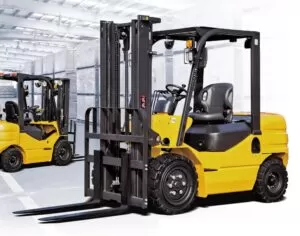
UAE summer is not simply a hotter version of the rest of the year. Between June and September, ambient temperatures regularly sit in the mid-forties, humidity along the coast stays high overnight, and fine dust is constant. Equipment that runs without complaint in February will find its weakest component in July — and it will usually find it mid-shift, fully loaded.The work below is straightforward. What matters is doing it before the heat arrives rather than in response to the first breakdown.
1. Cooling Systems: The First Thing to Fail
Dust is the real enemy, not heat alone. A radiator or oil cooler with clogged fins loses efficiency long before it looks blocked, and on a diesel machine that shows up as creeping coolant temperature and reduced power under load.
Back-flush radiator and oil cooler fins with compressed air — from the fan side outwards, not inwards.
Check coolant strength and level, not just level. Coolant that has been topped with water through the winter has lost boil protection.
Inspect hoses for softening and clamps for corrosion. A hose that survives 30°C may not survive 48°C.
Check the fan belt tension and the condition of the fan shroud — a missing shroud costs measurable cooling.
On dusty sites, move radiator cleaning to a weekly task for the summer months. If you are seeing repeat overheating, our forklift repair and maintenance team can assess whether the cooling system is undersized for the duty rather than simply dirty.
2. Hydraulics: Heat Thins the Oil
Hydraulic oil loses viscosity as it heats. Thinner oil means more internal leakage past seals and valves, which shows up as slower lift speeds, mast drift under load and a system that runs hotter still — a loop that gets worse across a shift.
Check the oil grade against the manufacturer’s hot-climate recommendation. A viscosity grade suited to a European summer may be too light for July in Jebel Ali.
Look for weeping seals and cylinder rod scoring during the pre-summer service, not after.
Keep the reservoir at the correct level. Under-filling reduces the oil’s ability to shed heat between cycles.
Watch for mast drift on a loaded static test — it is the earliest reliable symptom.
3. Batteries: Where Heat Costs the Most Money
Heat shortens battery life more than any other single factor. Battery University puts it plainly: each 8°C (15°F) rise in temperature cuts the life of a sealed lead-acid battery in half, measured against a 25°C reference. A UAE charging room that sits at 35°C or above through the summer is quietly halving the working life of every battery in it.
Lead-acid
Increase watering frequency. Evaporation rises sharply in heat and plate exposure causes permanent damage.
Ventilate and, where practical, cool the charging area. This is the highest-return intervention available.
Allow batteries to cool before charging where the duty cycle permits it. Charging a hot battery compounds the damage.
Keep terminals and tops clean — acid film and dust together conduct and accelerate self-discharge.
Lithium-ion
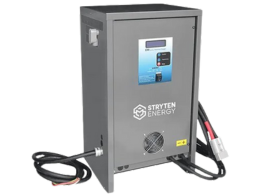
Lithium chemistries tolerate heat better than lead-acid and support opportunity charging, which removes the battery change and the charging room from the equation. Liftronic introduced the UAE’s first lithium-ion battery-powered rental forklift fleet in 2019, and hot-climate performance is a large part of why customers move across. See our electric forklift range and forklift charger options.
4. Tyres and Ground Conditions
Yard surfaces in the UAE reach temperatures far above ambient. Solid and cushion tyres soften, wear faster and can debond from the rim under sustained heat and load. Pneumatic tyres gain pressure as they heat and lose it as they cool, so a pressure set in the cool of early morning will not be correct at midday.
Check pressures at a consistent point in the shift and record it.
Inspect for chunking, cracking and heat separation at the rim weekly rather than monthly.
Reduce yard travel speeds where you can — heat build-up in tyres is a function of speed and distance.
5. The Cold Store Transition
This one is specific to the UAE and it catches operations out. A truck moving between a chiller at 2°C and a yard at 48°C several times a shift experiences a temperature swing of 46 degrees, and every transition condenses moisture onto electrical connectors, contactors and control boards. The damage is cumulative and shows as intermittent faults that are difficult to diagnose. Equipment specified for this duty — sealed connectors, conformal-coated boards, appropriate heaters — handles it; general-purpose equipment does not. See our cold store forklift solutions if this describes your operation.
6. Operators and the Midday Break
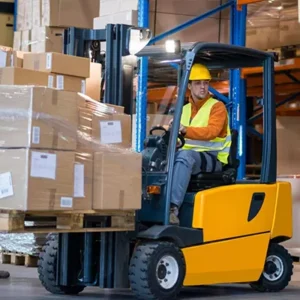
Equipment readiness is only half of it. From 15 June to 15 September, the UAE Ministry of Human Resources and Emiratisation bans work in direct sunlight and open areas between 12:30 and 15:00, and enforces it through inspection teams and reported violations. Yard and outdoor material handling has to be scheduled around that window.
Plan the heaviest outdoor movements into the morning, before the break window.
Check that cab fans, air conditioning and canopies are working before the season, not during it.
Watch for heat effects on performance — fatigued operators make contact errors, and contact errors damage racking, product and people.
This is also the point in the year where forklift cameras and proximity detection pay for themselves. Reduced concentration and glare are a bad combination in a busy yard.
7. Shorten the Service Interval for the Season
Service intervals published by manufacturers assume moderate operating conditions. Sustained 45°C-plus operation in dusty conditions is not moderate. Most UAE fleets benefit from bringing intervals forward through the summer months — particularly for air filters, oil and greasing points — and returning to standard intervals in October.If your fleet is owned rather than rented, a seasonal service contract covering the summer months is usually cheaper than the breakdowns it prevents. Liftronic provides preventive maintenance and AMC support across the UAE for both owned and rented equipment.
Pre-Summer Checklist
Check
Frequency through summer
Radiator and oil cooler fins blown out
Weekly on dusty sites
Coolant strength and level verified
Monthly
Hydraulic oil grade and level checked, drift test
Before season, then monthly
Battery watering (lead-acid)
Increased frequency — check weekly
Charging area ventilation and temperature
Before season
Tyre pressure and heat damage inspection
Weekly
Air filter condition
Every service, brought forward
Cab fan / air conditioning / canopy
Before season
Cold store equipment sealing and connectors
Before season
Operator schedule adjusted for midday break
Before 15 June
If a machine is already struggling through the season, replacing it temporarily is often faster and cheaper than repeated repairs. Short-term forklift rental can cover a unit while it is rebuilt, or through the peak months while your own fleet works a lighter duty. Contact Liftronic to arrange a summer readiness inspection.
There is no single cut-off. Most forklifts operate normally into the low forties if the cooling system is clean and serviced. Problems appear where dust has blocked coolers, hydraulic oil is too light for the climate, or batteries are charged and stored in an uncooled room.
Significantly. Each 8°C rise above 25°C halves the life of a sealed lead-acid battery, so an uncooled charging room running at 35°C through the summer can cut battery life by around half. Watering frequency also has to increase because evaporation rises with temperature.
Check the grade rather than assume. Hydraulic oil thins as it heats, and an oil suited to a temperate climate can be too light for sustained UAE summer operation, causing slow lift and mast drift. Your manufacturer will publish a hot-climate viscosity recommendation.
It applies to work in direct sunlight and open areas between 12:30 and 15:00 from 15 June to 15 September, so outdoor yard and container handling must be scheduled around it. Enclosed warehouse operations are not covered by the ban, but heat management indoors still matters.
Lithium-ion generally tolerates heat better than lead-acid and supports opportunity charging, which removes battery changes and the charging room entirely. It is one of the main reasons UAE operations move across, though the machine still needs the same cooling, hydraulic and tyre care as any other.

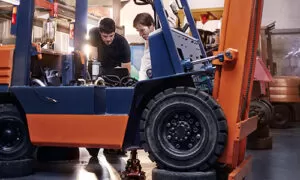 UAE summer is not simply a hotter version of the rest of the year. Between June and September, ambient temperatures regularly sit in the mid-forties, humidity along the coast stays high overnight, and fine dust is constant. Equipment that runs without complaint in February will find its weakest component in July — and it will usually find it mid-shift, fully loaded.The work below is straightforward. What matters is doing it before the heat arrives rather than in response to the first breakdown.