
Racking and Forklifts Are One Decision, Not Two
Most warehouses choose racking first and think about the forklift later. That is how sites end up with aisles a reach truck cannot turn in, double-deep bays with no telescopic forks to reach the back pallet, or top beams the existing truck cannot safely lift to. The racking and the truck have to be chosen together.
Liftronic does not sell or install racking. We supply the forklifts that work in it, so we see the consequences of a mismatch from the forklift side. This guide explains the main pallet racking systems, what each one is good at, and which truck it needs.
Answer These Questions First
- How many product lines (SKUs) do you hold, and how many pallets of each? Many lines with few pallets each need direct access; few lines with many pallets suit dense storage.
- Does stock have to rotate first-in-first-out? Food, pharmaceuticals and anything with a date code usually does.
- How many pallet movements per hour? Dense systems store more but are often slower to work.
- How high can you go? Clear height to the sprinklers sets the top beam (see how to maximise vertical warehouse storage).
- Which trucks do you have, or will you rent? This sets the aisle width.
The Main Pallet Racking Systems
Selective (adjustable) pallet racking
The standard warehouse rack: rows of upright frames and beams, one pallet deep from each aisle. The UK HSE’s HSG76 guide defines its key feature simply: each pallet storage position can be accessed individually. It suits sites with many SKUs and frequent picking. The trade-off is space, because every row needs its own aisle. Works with: counterbalance forklifts, reach trucks and articulated forklifts.
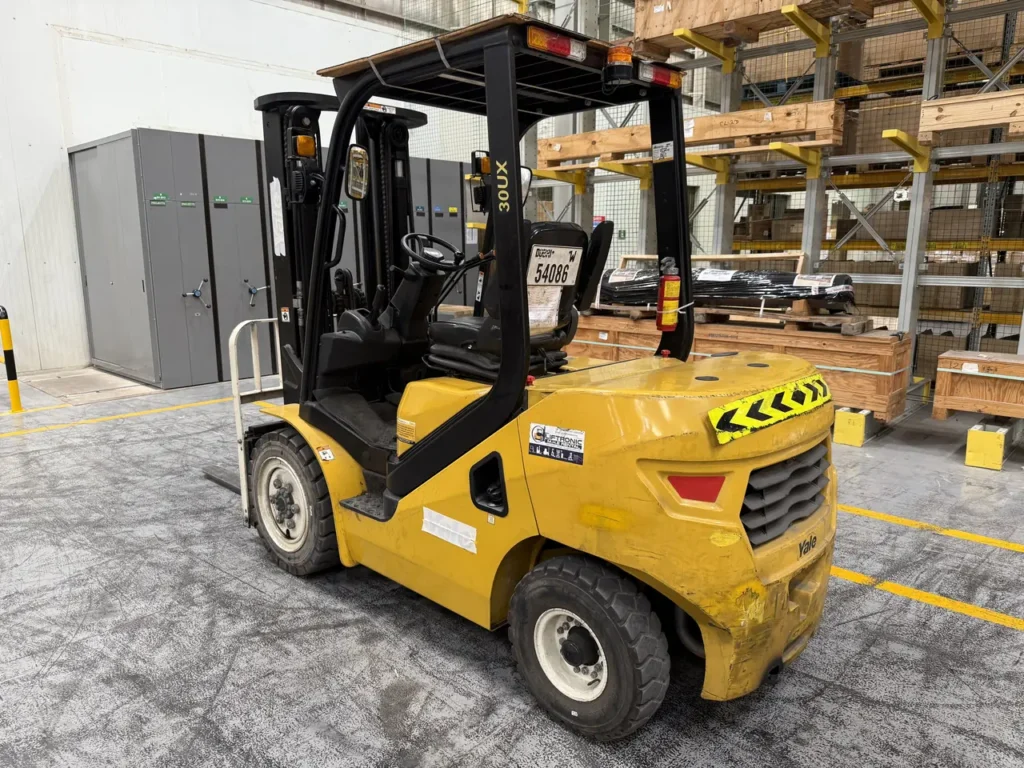
Double-deep racking
Two selective racks placed back to back on each side of the aisle, so every aisle serves four pallets deep instead of two. Mecalux notes that forklifts used with this configuration should be equipped with telescopic forks. You lose direct access to the rear pallet, so it suits lines with at least two pallets each. Works with: a reach truck with a telescopic reach fork, such as a Linde double-deep reach truck.
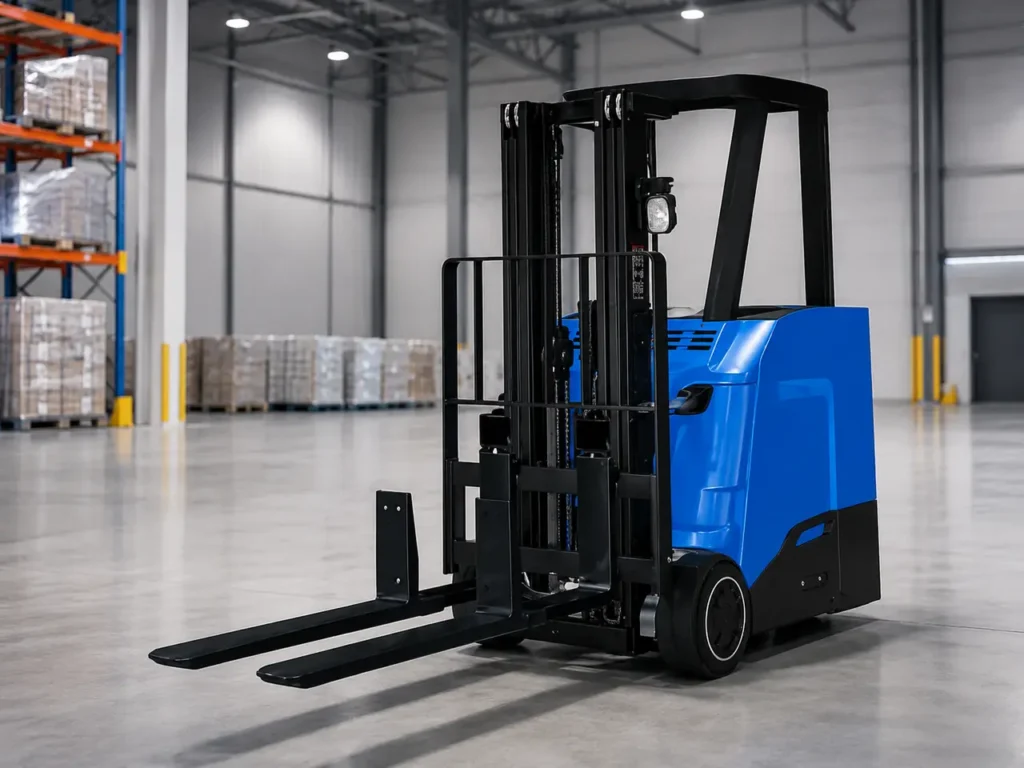
Narrow aisle and very narrow aisle (VNA) racking
Selective racking with the aisles squeezed. Mecalux describes very narrow aisles as typically 1.5 to 1.9 m wide, worked by turret trucks guided by rails or a floor wire. Articulated forklifts reach similar widths without guidance and can also work outside. Works with: VNA turret trucks, articulated forklifts and order pickers for case picking. Our introduction to articulated forklifts explains the difference.
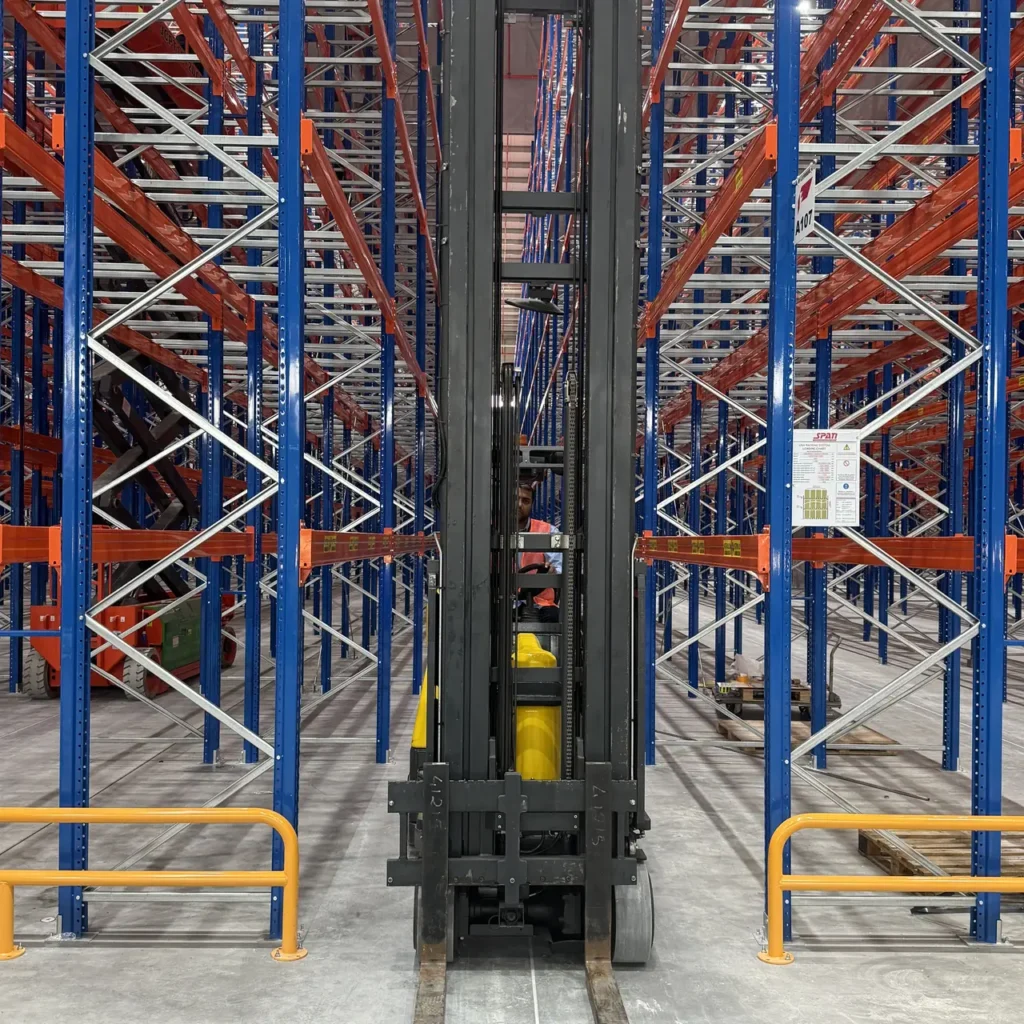
Drive-in and drive-through racking
Deep lanes with rails instead of beams; the truck drives into the structure to place and retrieve pallets. HSG76 defines it: in drive-in, the lift truck drives into a lane and reverses out; in drive-through, it may drive through from one aisle to another. Mecalux points out that drive-in stock is managed last in, first out, while drive-through runs first in, first out, and calls drive-in the simplest and most affordable high-density storage method. It suits large quantities of few products. Works with: counterbalance forklifts and reach trucks.
Push-back racking
Pallets sit on carts or rollers on a slight incline. Loading a new pallet pushes the others back; taking one out lets the next roll forward. HSG76 notes that push-back is first-in-last-out and is suitable for pallets only. It gives dense storage from a single aisle, with faster access than drive-in. Works with: counterbalance forklifts and reach trucks.
Pallet flow (live) racking
Pallets are loaded at the higher end and slide by gravity to the picking face at the other end. HSG76 notes that this method ensures first-in-first-out, which makes it a natural fit for dated stock. It needs separate loading and picking aisles and carefully specified pallets. Works with: counterbalance forklifts and reach trucks at each end.
Mobile racking
Selective racks mounted on motorised bases that slide along floor rails, opening one aisle at a time. Mecalux reports that it achieves an increase in storage capacity of between 80% and 120% compared with static racks, at the expense of a less agile operation. It suits cold stores and archives, where space is expensive and throughput is modest. Works with: reach trucks and counterbalance forklifts.
Cantilever racking
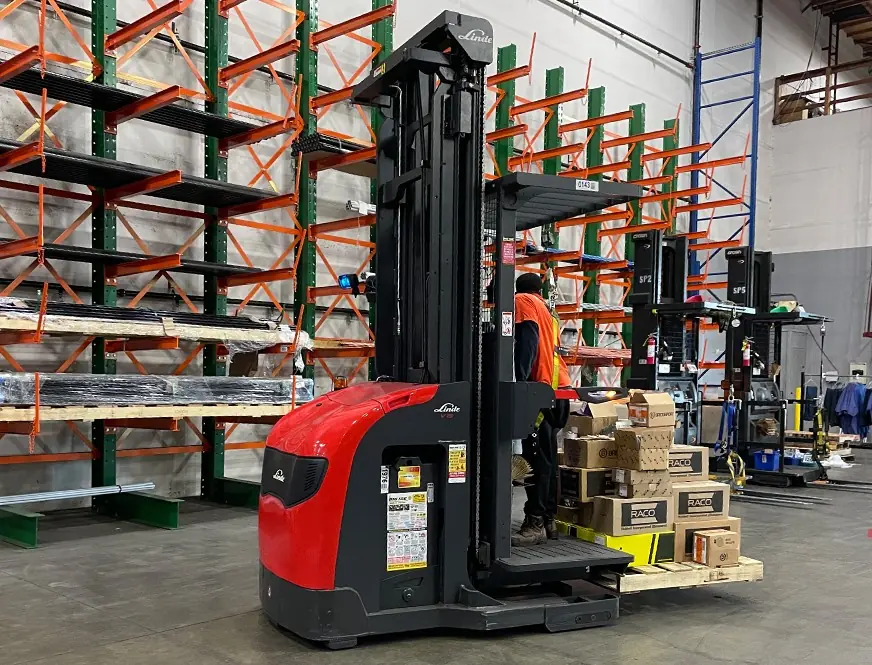
Arms instead of beams, with no front uprights, for long loads such as pipes, steel sections and timber. Handling long loads safely usually calls for a multidirectional truck that can travel sideways with the load, such as a Combilift.
At a Glance
| System | Access to each pallet | Stock rotation | Space use | Typical truck |
|---|---|---|---|---|
| Selective | Every pallet | Any | Lowest | Counterbalance, reach, articulated |
| Double-deep | Front pallet only | Mostly LIFO | Higher | Reach truck + telescopic forks |
| Narrow aisle / VNA | Every pallet | Any | High | Articulated, VNA turret |
| Drive-in | Front of lane | LIFO | Very high | Counterbalance, reach |
| Drive-through | Front of lane | FIFO | Very high | Counterbalance, reach |
| Push-back | Front of lane | LIFO | High | Counterbalance, reach |
| Pallet flow | Front of lane | FIFO | High | Counterbalance, reach |
| Mobile | Every pallet (one aisle open) | Any | Very high | Reach, counterbalance |
Matching the Forklift to the Racking
Aisle width is the first constraint. Mecalux gives typical working aisles of 3.2 to 3.5 m for counterbalance forklifts and 2.7 to 2.9 m for reach trucks, which can operate up to 10.5 m high, and 1.5 to 1.9 m for turret trucks. Combilift quotes 1.6 m for its Aisle Master articulated trucks.
Lift height and capacity come next. A truck’s capacity falls as the mast extends, so check the rated capacity at your top beam with your real pallet weight, not the headline figure. HSG76 is clear that safe working loads, heights, widths and equipment tolerances should be set by the designers and manufacturers of the total system, which means the racking designer needs your truck’s specification before the drawings are final.
Finally, think about the load itself. Mixed pallet sizes, drums, rolls or bales may need a forklift attachment such as a fork positioner or a side shifter, and that changes the truck’s capacity again.
Keeping Racking Safe
- Load notices. HSG76 says racking should have a clear notice securely fixed to it stating the maximum load and any specified load configurations, and those limits should never be exceeded.
- Regular inspections. HSG76 recommends in-house inspections at weekly or other regular intervals based on risk, plus an inspection by a technically competent person at intervals of not more than 12 months. SEMA, the UK storage equipment association, says an expert inspection is conducted at least once a year.
- Act on damage. SEMA’s traffic-light system treats red damage as needing the racking offloaded and put out of use immediately, and amber as needing remedial work. HSG76 adds that amber damage should be redesignated red if it is not repaired within four weeks.
- Protect the uprights. HSG76 recommends renewable column guards, with corner uprights protected by a device in a conspicuous colour. Check that guards do not eat into the clearance the truck needs.
- Respect the sprinklers. Dubai Municipality’s safe storage guidelines require stored material to be at least 45 cm from sprinkler heads, and sprinkler design must follow the UAE Fire and Life Safety Code.
At eight metres and above, operators often cannot see the beam or the forks clearly. Dubai Municipality’s External Circular 01/2026 requires 360-degree cameras and proximity sensors on forklifts by 1 January 2027; a forklift camera system helps on both counts.
Get the Truck Right Before the Racking Goes Up
Send your racking supplier’s layout to us before it is final. We will check the aisle widths, top beam heights and pallet sizes against the trucks that suit them, and you can rent the right truck to trial the layout before committing. Liftronic’s rental fleet covers reach trucks, articulated and Combilift forklifts, counterbalance trucks and order pickers, maintained by our own repair and service team.
Send us your layout for a forklift recommendation.
Frequently Asked Questions
What is selective pallet racking?
Selective, or adjustable, pallet racking is the standard warehouse rack of upright frames and beams, one pallet deep from each aisle. Every pallet position can be accessed individually, which suits warehouses with many product lines and frequent picking.
Which pallet racking system stores the most pallets?
Dense systems such as drive-in, push-back, pallet flow and mobile racking store the most in a given floor area. Mecalux reports that mobile racking increases capacity by 80% to 120% compared with static racks. The trade-off is slower or restricted access to individual pallets.
What forklift do I need for double-deep racking?
A reach truck fitted with telescopic forks, which extend to reach the rear pallet. Mecalux notes that forklifts used with double-deep racking should be equipped with telescopic forks.
How often should pallet racking be inspected?
The UK HSE’s HSG76 recommends in-house inspections at weekly or other regular intervals based on risk assessment, and an inspection by a technically competent person at intervals of not more than 12 months.
What is the difference between drive-in and drive-through racking?
In drive-in racking the truck drives into a lane and reverses out, so the last pallet in is the first out. In drive-through racking the truck can drive through the block from one aisle to the other, which allows first-in-first-out stock rotation.
References
- UK HSE — HSG76 Warehousing and storage: A guide to health and safety (racking types, load notices, inspections)
- SEMA — What is a SEMA approved racking inspector?
- Mecalux — Pallet racking (selective and double-deep)
- Mecalux — Drive-in pallet racking
- Mecalux — Choosing the ideal system for storing pallets
- Mecalux — Pallet rack guide
- Mecalux — VNA pallet racking
- Mecalux — Types of forklifts and their aisle widths
- Combilift — Aisle Master
- Dubai Municipality — Technical Guidelines for Safe Storage, DM-HSD-148-SS2 (June 2026)
- Dubai Municipality — External Circular 01/2026, Safe Forklift Operation (10 Jun 2026)