
Dubai Municipality forklift safety requirements are now firmly on the agenda for every warehouse, factory and distribution centre in Dubai. In particular, two official documents set the direction: the Safe Forklift Operations Technical Guideline and External Circular (01/2026). Together, they call for 360 degree cameras, proximity sensors, traffic management plans, inspections and trained operators. Moreover, the circular sets a compliance deadline of 1 January 2027.
This guide first explains what the documents say. Then it shows how a 360 degree forklift camera and a forklift proximity sensor reduce collision risk. Finally, it covers what to check before you install forklift safety systems in the UAE, and where to buy and install a forklift camera system in Dubai.
Key takeaways
- First, External Circular (01/2026), reference DM-EHS-CR01, requires industrial establishments using forklifts to install and implement listed safety systems, including 360 degree cameras and proximity sensors.
- Second, all measures must be fully implemented no later than 1 January 2027, and inspectors will check compliance.
- In addition, the technical guideline (DM-HSD-146-FL2) explains how cameras, sensors and warning lights should be installed, calibrated, tested and recorded.
- However, cameras and sensors only supplement physical separation, safe procedures and operator training. They do not replace them.
Dubai Municipality Forklift Safety Requirements: What the Official Documents Say
Safe Forklift Operations Technical Guideline (DM-HSD-146-FL2)
Dubai Municipality's Health & Safety Department issued the Safe Forklift Operations Technical Guideline (Version 1.0) on 15 December 2025. It applies to all warehouses, factories and distribution centres. Specifically, it covers forklift traffic and its interaction with pedestrians, contractors and visitors across loading bays, production lines, storage aisles, pedestrian walkways, external yards, workshops, charging stations and cold room areas.
In other words, almost every area where a forklift works falls within its scope.
The guideline also follows a hierarchy of controls. First, eliminate shared spaces where possible. Next, separate pedestrians and forklifts physically. Then add engineering controls. For example, it names 360 degree cameras, sensors and blue/red visual warning lights as engineering controls that cut the risk remaining after layout and separation measures are in place.
External Circular (01/2026) – Safe Forklift Operation (DM-EHS-CR01)
Later, on 10 June 2026, Dubai Municipality's Environment, Health & Safety Agency issued the circular to owners and operators of industrial establishments and warehouses. As a result, all industrial establishments using forklifts are now required to install and implement the following safety systems:
- Traffic management plan that separates forklift routes from pedestrian pathways, as well as barriers, signs and speed limits
- 360 degree cameras on forklifts so that operators have full visibility and fewer blind spots
- Proximity sensors that issue visual or audible alerts when the forklift approaches obstacles
- Visual warning systems, for example blue and red spotlights, which are recommended to project warning zones on the ground
- Daily pre-operation inspections and periodic maintenance, as well as an inspection log
- Correct loading and handling within the forklift's rated capacity
- In addition, safe parking and shutdown, accredited operator training, seat belts, and a ban on carrying passengers or lifting people on forks
Above all, the circular's important notes are clear. The measures must be fully implemented no later than 1 January 2027. Furthermore, routine inspections will verify compliance. Consequently, violations and penalties will apply under Dubai Municipality legislation for non-compliance.
Why Forklift Blind Spots Lead to Collisions
A forklift operator's view is blocked by the mast, the load, the overhead guard and the counterweight. Moreover, the problem gets worse when reversing, turning at aisle ends, entering narrow aisles or carrying bulky loads. In fact, the Dubai Municipality guideline highlights high traffic, congested spaces, limited visibility and pedestrians working nearby as the main reasons for collisions, tip-overs and falling loads.
Mirrors help. However, they cannot show the whole area around the truck. That is why a 360 degree forklift camera and a forklift proximity sensor are designed to close this gap.
How a 360 Degree Forklift Camera Works
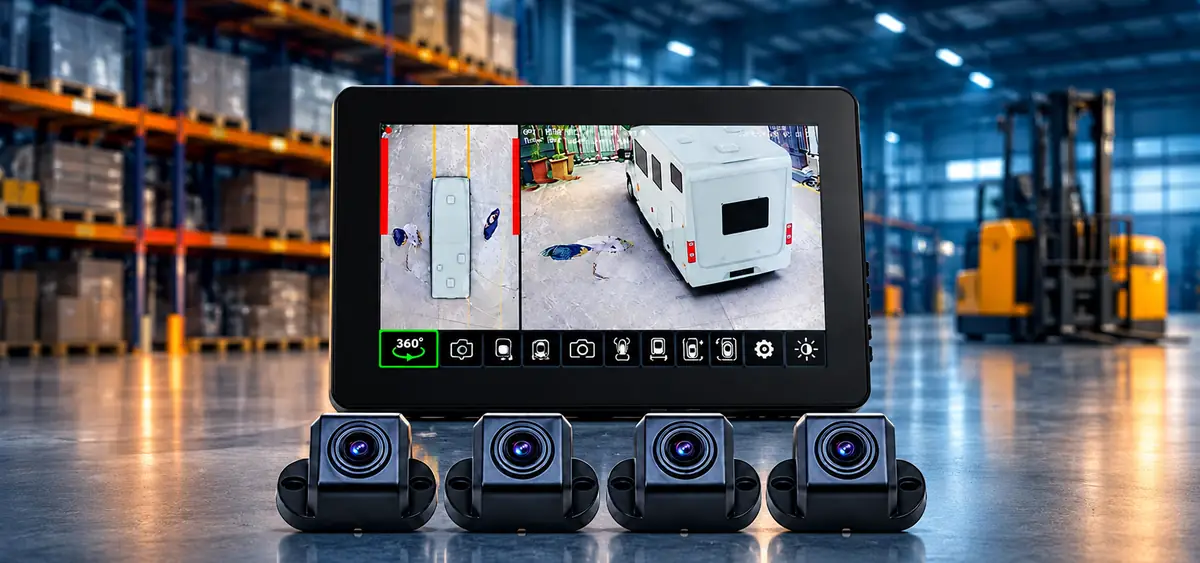
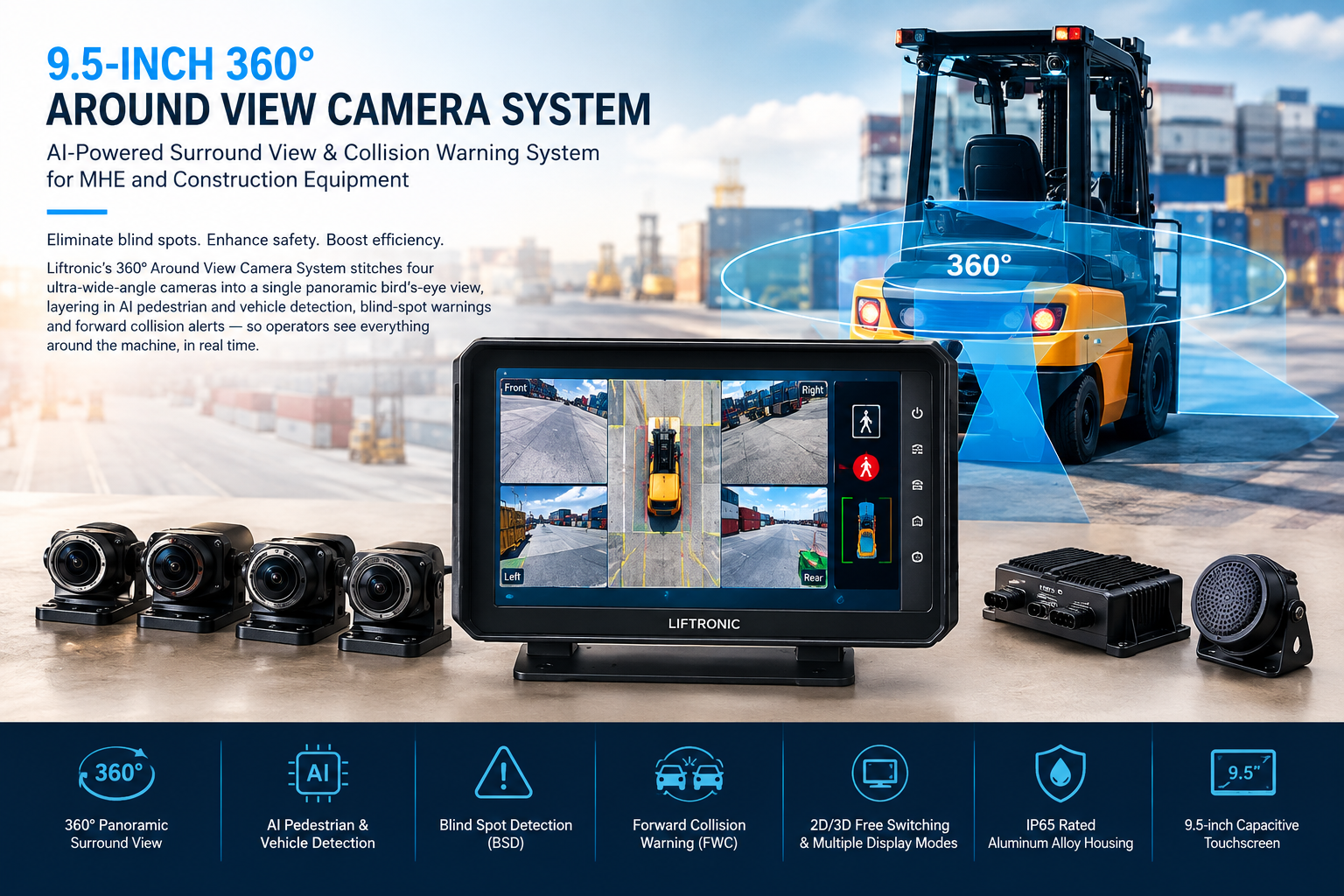
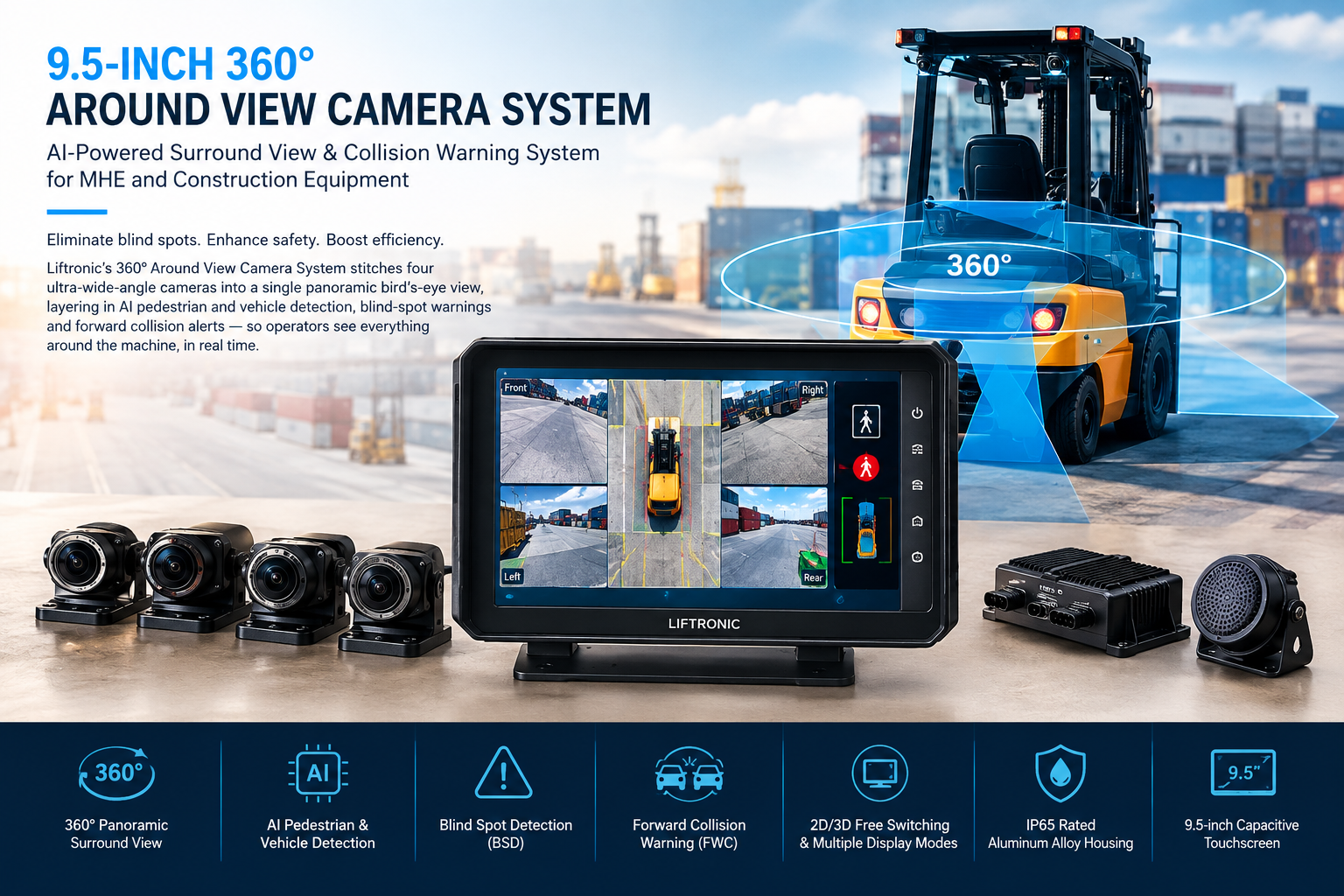
A 360 degree camera system uses four wide-angle cameras on the front, rear and both sides of the forklift. The system then stitches the images into a single bird's-eye view on a monitor in the operator's cab. As a result, the operator can check all sides of the truck before moving. Because it covers every side at once, it also works as a forklift blind spot camera when reversing, turning and manoeuvring at aisle ends.
In addition, the technical guideline sets out specific points for 360 degree camera installations:
- Four wide-angle cameras mounted securely on the front, rear and both sides so that all blind spots are covered.
- An additional mast camera when a raised load or the mast blocks the forward view.
- Industrial-grade components, such as cameras and wiring rated IP67 or higher, because they must withstand vibration, dust and moisture.
- Monitor placement within the operator's line of sight, for example on a corner post of the overhead guard, while never blocking the view through any window.
- Auto-view switching linked to travel direction, so that the most relevant view appears without extra operator input.
- Alert priority, especially when cameras are combined with proximity sensors or AI pedestrian detection.
- Calibration by the installer immediately after installation, and then regular function tests by a competent technician, with records kept.
Similarly, the guideline states that reversing is permitted only when unavoidable. Even then, the path must be clear, rear visibility must come from the rear camera or mirrors, and a trained banksman must direct the move when pedestrians may be present.
How a Forklift Proximity Sensor Works
A forklift proximity sensor, often called a forklift pedestrian detection system or forklift collision avoidance system, detects people or obstacles inside a defined zone around the truck. It then alerts the operator with a visual and/or audible warning. Depending on the application, systems can use ultrasonic sensors, radar or laser scanners.
According to the Dubai Municipality guideline, proximity warning sensors should be fitted to forklifts operating in high-risk areas.
In particular, the guideline names shared pedestrian zones, blind corners, transfer points, dock approaches and high-rack areas.
Detection zones should match site speeds and stopping distances. Therefore, a setting that works in one warehouse may not suit another. Operators and pedestrians should also be trained on what the alerts mean and on the limits of the system. Furthermore, trials should record zone maps, detection tests with dummy targets and lighting conditions across work shifts. Finally, detection zones and sensor response must be verified monthly through functional testing, with inspection records retained.
360 Degree Camera vs Proximity Sensor: Do You Need Both?
The two technologies do different jobs. That is why Dubai Municipality lists them separately:
- 360 degree camera: it shows the operator what is around the forklift, so that they can judge space, people and obstacles during a manoeuvre.
- Proximity sensor: in contrast, it actively warns the operator when someone enters the danger zone, even when the operator is not looking at the screen.
In short, the camera provides the picture while the sensor provides the alarm. Combining both on one system also makes it easier to meet the guideline's requirement that alerts are clearly prioritised.
Blue and Red Forklift Warning Lights
Cameras and sensors help the operator see. Blue and red forklift warning lights, on the other hand, help pedestrians see the forklift. For this reason, External Circular (01/2026) recommends blue and red spotlights that project warning zones on the ground, so that people can see the forklift's path before it reaches them. In addition, the technical guideline (section 4.4.2) explains how to set them up.
Blue spot light: shows where the forklift is heading
A blue forklift spot light projects a bright dot on the floor ahead of or behind the truck. Accordingly, the guideline sets out these points:
- First, fit blue forward and rear spot lights where pedestrians may meet forklifts.
- Then set the projection distance to the space and speed rather than a fixed value: about 1–2 m in narrow aisles and about 3–6 m in wide aisles and open areas.
- When a site has both narrow and wide aisles, use the narrow-aisle distance by default.
- Also increase the distance at higher travel speeds and when approaching blind corners, dock doors or busy junctions.
- Finally, mount the lights securely on the overhead guard and adjust the aim so that the spot lands at the intended distance.
Red halo light: marks the danger zone around the forklift
A red zone light, also called a red halo or red line light, projects a line on the floor alongside the truck. As a result, pedestrians can see where not to step. The guideline recommends:
- Combining the blue spot with red halo lights where pedestrians are present, especially at aisle ends and turns.
- Aiming the red line 0.5–1.0 m from the outermost point of the truck on both sides.
- However, increasing this to 1.2–1.5 m in high-speed open areas, or where pedestrians usually walk close to forklifts.
- Continuing the arc to about 180° around the counterweight where feasible; otherwise, about 120–150° in very tight aisles.
Setting up and testing the warning lights
During commissioning, the guideline advises:
- First, measuring where the beam lands with a tape measure.
- Next, running walk-through trials with spotters.
- Then fine-tuning the distance for floor reflectance, lighting, aisle width and congestion.
- Finally, checking that the projection stays visible in bright zones and areas with skylights.
Where Forklift Safety Systems in the UAE Make the Biggest Difference
- Narrow-aisle and high-rack warehouses, because visibility is restricted when turning, reversing and placing pallets at height.
- JAFZA and Jebel Ali logistics facilities, since busy loading bays, transfer points and mixed routes are common.
- Manufacturing and production areas, where forklifts work close to staff and machinery.
- Loading and unloading bays, as space is tight and trucks and trailers move constantly.
- Cold rooms and freezer stores, because fogging, low light and heavy PPE reduce awareness.
Liftronic MHE Rental's AI 360 Degree Forklift Camera System
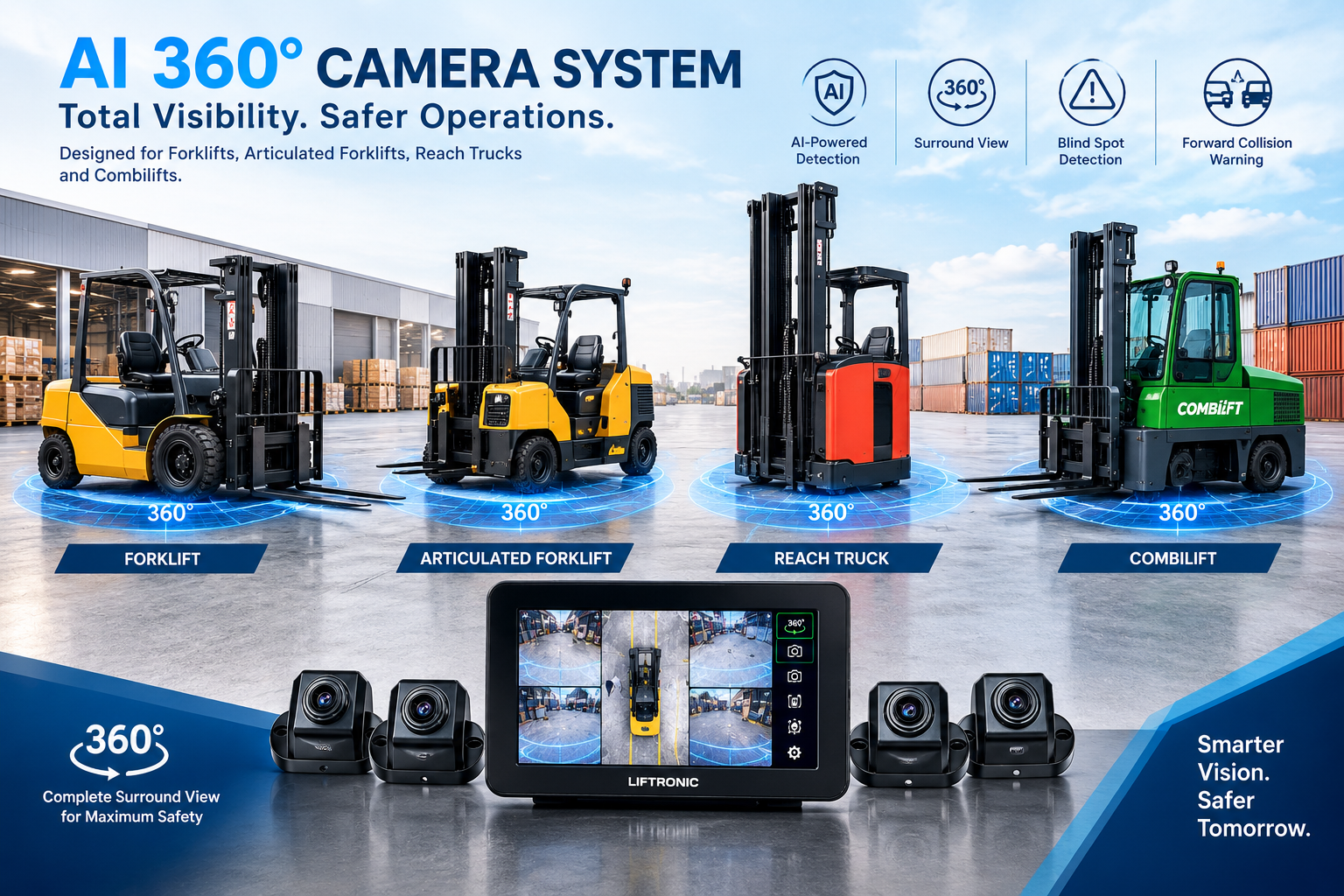
With this in mind, Liftronic Machinery and Equipment Rental L.L.C. supplies and installs an AI 360 degree forklift camera with proximity sensor for forklifts, reach trucks and other material handling equipment. In fact, the system is designed around the visibility and alert features that the Dubai Municipality documents describe.
- 360 degree surround view from a four-channel panoramic camera system
- AI detection of pedestrians as well as vehicles
- Four-channel blind-spot detection
- Forward collision warning with image-based distance measurement
- 9.5-inch capacitive touchscreen with 2D, 3D and multiple display layouts
- 1080P H.265 video recording, so that incidents can be reviewed
- Customisable voice warnings
- Industrial camera options, for example an IP68-rated camera specification in the product brochure
Optional proximity detection with automatic stop
In addition, an optional proximity detection module uses 16 ultrasonic probes with a stated detection distance of up to 2.5 metres. The brochure also describes an automatic-stop function when a real obstacle enters the configured protection zone. Other optional modules include radar warning, audio-visual alarms, lane-change assistance and parking assistance.
However, optional modules are not included in every installation. Therefore, compatibility, configuration and operating behaviour must be confirmed for the specific forklift before installation. Likewise, an automatic stop is never a substitute for operator control. Looking for other options? See our wider range of forklift camera solutions for forklifts and material handling equipment.
Buy a 360 Degree Forklift Camera in Dubai with Supply and Installation
So, if you want to buy a 360 degree forklift camera in Dubai, Liftronic Machinery and Equipment Rental L.L.C. supplies the complete forklift camera system and also installs it on site. We work with warehouses, logistics companies, factories and cold stores in Jebel Ali, JAFZA, Dubai Investment Park, Al Quoz, Abu Dhabi, Sharjah and across the UAE.
Our forklift camera installation in Dubai and the UAE covers:
- First, an application assessment and compatibility check for your forklift, reach truck or other material handling equipment
- Then supply of the AI 360 degree forklift camera system, as well as optional proximity sensor and automatic-stop modules
- Next, installation of the cameras, in-cab monitor and wiring
- After that, calibration and detection-zone configuration
- Finally, a quotation based on your forklift models and number of units
Need to equip a full fleet before the 1 January 2027 deadline? In that case, ask us for a fleet quotation for forklift safety systems in the UAE. Our team will then discuss a suitable installation schedule for your site.
Installation Checklist Before the 1 January 2027 Deadline
- First, review your traffic management plan and risk assessment to find where forklifts and pedestrians interact.
- Next, confirm front, rear and side camera coverage, and decide whether a mast camera is needed for raised loads.
- Also check the IP rating of the complete installed system, including cameras, wiring and display.
- Then mount the monitor within the operator's line of sight without blocking any window.
- After that, decide whether proximity sensors, AI detection or an automatic-stop module suit your risk level.
- Similarly, set detection zones to your forklift speeds, stopping distances and aisle layout.
- Once installed, calibrate the system and keep calibration and test records.
- In addition, train operators on the display, alerts and system limitations, and keep training records.
- Finally, add lens cleaning, sensor checks and alarm tests to the pre-shift inspection, and test detection zones monthly.
Cameras and Sensors Do Not Replace Safe Forklift Operations
Importantly, the guideline is explicit that technology should supplement, not replace, physical separation, guarding and safe systems of work. Therefore, alongside camera and sensor systems, establishments should:
- Physically separate pedestrian routes from forklift routes, as well as install barriers, bollards and marked crossings.
- Allow only authorised, competent operators, and also use a key control system to prevent unauthorised use.
- Ensure forklifts and attachments are inspected and certified annually by EIAC-accredited inspection bodies.
- Provide third-party certified and refresher training for all operators, including outsourced staff.
- Complete a documented inspection before every shift; moreover, take defective forklifts out of service until repairs are signed off.
- Manage travel speeds, keep forks low, face the direction of travel and always wear seat belts.
- Finally, consider blue and red visual warning lights so that pedestrians can see the forklift's path and danger zone.
Frequently Asked Questions
Is a 360 degree camera mandatory for forklifts in Dubai?
Yes. In fact, Dubai Municipality's External Circular (01/2026), reference DM-EHS-CR01, lists 360 degree cameras among the safety systems that industrial establishments using forklifts are required to install and implement by 1 January 2027. Therefore, review the circular and the technical guideline against your own operations.
Are proximity sensors required on forklifts in Dubai?
Yes, proximity sensors are also on the circular's list of required safety systems. In addition, the technical guideline specifies fitting them to forklifts working in shared pedestrian zones, blind corners, transfer points, dock approaches and high-rack areas.
What is the deadline for Dubai Municipality forklift safety compliance?
The circular states that all industrial establishments must fully implement the listed measures no later than 1 January 2027. After that, Occupational Health and Safety inspection teams will carry out routine inspections to verify compliance.
How many cameras does a 360 degree forklift camera system use?
A standard surround-view system uses four wide-angle cameras on the front, rear and both sides. In addition, the guideline recommends a mast camera when a raised load or the mast blocks the forward view.
How far can a forklift proximity sensor detect?
It depends on the technology and configuration. For example, Liftronic MHE Rental's optional ultrasonic module has a stated detection distance of up to 2.5 metres. However, zones must be set to your site's speeds and stopping distances and then tested under real conditions.
How often should forklift proximity sensors be tested?
The technical guideline requires detection zones and sensor response to be verified monthly through functional testing, with records retained. Furthermore, lens cleaning, sensor checks and alarm tests should form part of the pre-shift inspection.
Does a 360 degree camera replace forklift mirrors?
No. Although a camera system adds visual information, mirrors and other visibility controls should stay in place. Operators must also continue to follow the manufacturer's instructions and site procedures.
Can a 360 degree camera be fitted to reach trucks and other equipment?
Yes, as long as a compatibility check confirms the machine, camera positions, electrical supply and application. For this reason, a technical assessment is recommended before installation.
Where can I buy a 360 degree forklift camera in Dubai?
Liftronic Machinery and Equipment Rental L.L.C. supplies and installs AI 360 degree forklift cameras with optional proximity sensors in Dubai and across the UAE. So, share your forklift make, model and number of units, and we will then prepare a quotation.
Do you provide forklift camera installation in Abu Dhabi and Sharjah?
Yes. Liftronic MHE Rental also supplies and installs forklift camera systems across the UAE, including Abu Dhabi and Sharjah. However, each machine needs a compatibility check first.
What is a forklift pedestrian detection system?
It is a system that detects people near a forklift and then warns the operator. For example, it can use AI camera detection, ultrasonic sensors, radar or laser scanners. Similarly, Liftronic MHE Rental's 360 degree forklift camera includes AI detection of pedestrians and vehicles, as well as an optional ultrasonic proximity module.
Is a forklift camera with proximity sensor enough to comply with the Dubai Municipality circular?
Not on its own. Although a 360 degree camera and proximity sensor system covers two of the safety systems listed in the circular, the circular also requires a traffic management plan, inspections and maintenance, safe loading, accredited operator training and other controls. In addition, it recommends visual warning lights.
Are blue and red forklift lights mandatory in Dubai?
Not strictly. Although External Circular (01/2026) lists visual warning systems among its safety measures, it states that blue and red spotlights are recommended. Meanwhile, the technical guideline gives projection distances of about 1–2 m in narrow aisles and 3–6 m in open areas for blue spot lights, as well as 0.5–1.0 m from the truck for red halo lines.
Get Your Forklifts Ready for 1 January 2027
So, whether you run a warehouse in Jebel Ali, a factory in Dubai Investment Park or a distribution centre anywhere in the UAE, Liftronic Machinery and Equipment Rental L.L.C. can help. In particular, we help you choose the right 360 degree forklift camera and proximity sensor configuration for your forklift models and site layout. To get started, call or WhatsApp +971 52 248 3348, email info@liftronicme.com, or request a quotation.
Note: this article summarises Dubai Municipality's Safe Forklift Operations Technical Guideline (DM-HSD-146-FL2) and External Circular (01/2026) for general information. Therefore, always refer to the official documents and Dubai Municipality for your specific compliance obligations.